
How to prepare for an SAP sales consultant certification
A study method for the SAP sales consultant exams (C_TS462, C_S4CS, C_C4H47): map the journey, build the order-to-cash chain hands-on, then rehearse timed.
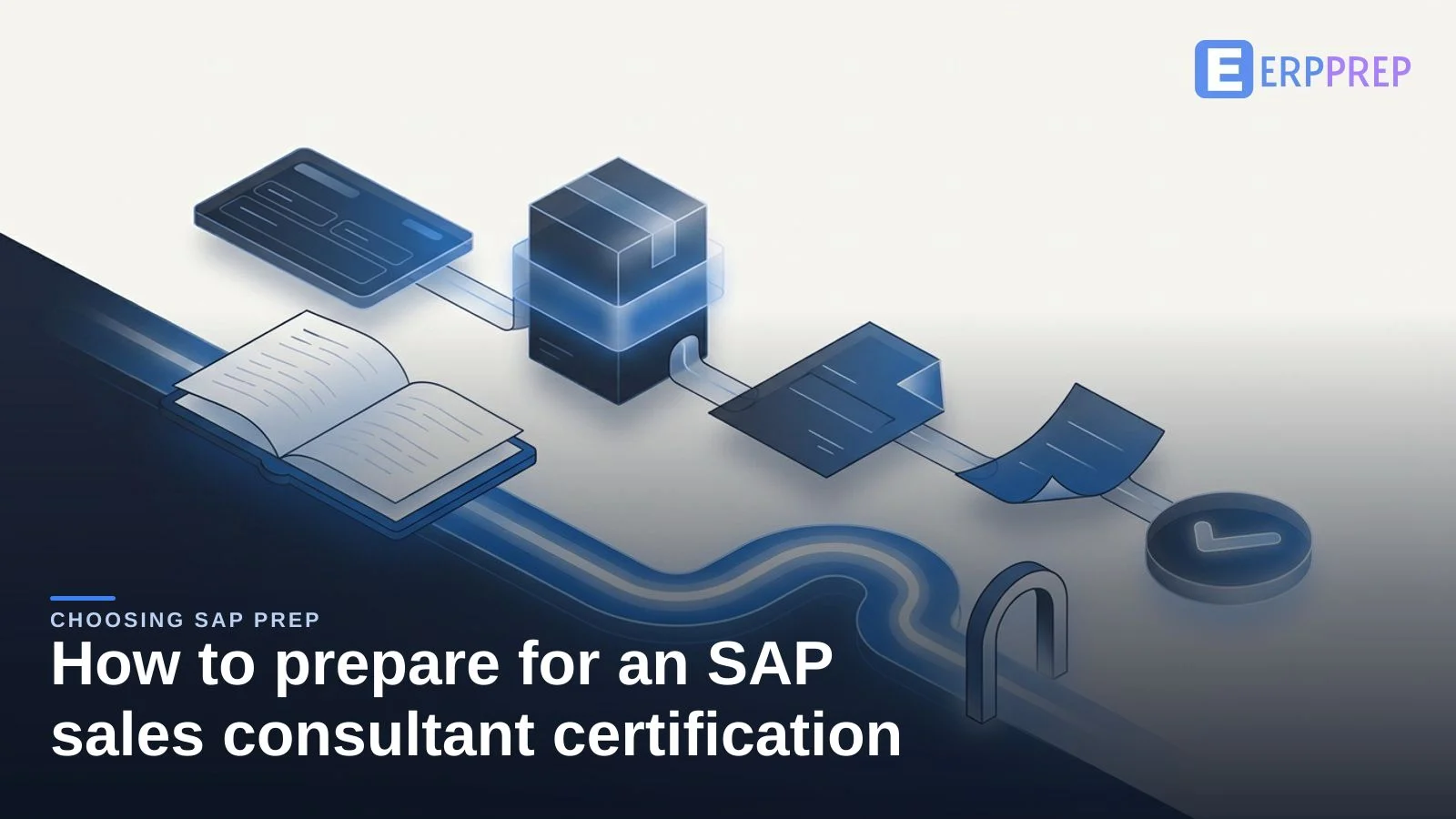
Prepare for an SAP® sales consultant exam by studying the process chain, not isolated screens. Map your exam's learning journey into a coverage grid, configure and run order-to-cash (or lead-to-order for SAP Sales Cloud) hands-on, drill pricing and copy control until routine, then rehearse timed tasks. C_TS462, C_S4CS and C_C4H47 are all System-Based Assessments.
SAP® has several certifications for sales consultants, and they look quite different on paper: a private-cloud sales exam (C_TS462, the exam many people still call "SD"), a public-cloud sales exam (C_S4CS), and one for SAP Sales Cloud Version 2 (C_C4H47). This guide is a study method for all three: how to read the syllabus, what to practise hands-on, how to plan the weeks and how to rehearse. It is not a career guide — if you are still choosing which exam fits your role, start with the best SAP certification for a sales career. For the general method behind every SAP exam, see how to prepare for SAP certification.
The short version: sales exams reward people who understand how one document becomes the next, so study the chain before the details, and practise doing the configuration rather than reading about it. If you want to feel what task-shaped practice is like before you plan anything, try a free sample and compare it with how your exam runs.
Key takeaways
- All three are System-Based. C_TS462, C_S4CS and C_C4H47 are System-Based Assessments (SyBA), so hands-on practice should take up most of your plan.
- C_TS462 sets the highest bar. Its exam page lists an 82% cut score; C_S4CS and C_C4H47 list 75%.
- The journeys differ hugely in size. Roughly 80+ hours for C_TS462, about 50 for C_S4CS and about 10 for C_C4H47, per learning.sap.com.
- Study the chain first. Order to delivery to billing (or lead to order in SAP Sales Cloud) gives every configuration setting its meaning.
- Pricing and copy control are the backbone. They appear in both S/4HANA sales journeys — drill them until they are routine.
Which sales exams does this guide cover?
All facts below come from each exam's page and learning journey on learning.sap.com. Confirm them before you book, because SAP updates exams over time. The exam pages do not list topic weightings at the time of writing, so treat the learning journey as your syllabus.
- C_TS462 — S/4HANA Cloud Private Edition, Sales. System-Based, 82% cut score. SAP positions it as an entry-level credential and notes that it applies to on-premise SAP S/4HANA as well as Private Edition. The learning journey is rated intermediate, lists twelve courses and runs to more than 80 hours.
- C_S4CS — S/4HANA Cloud Public Edition, Sales. System-Based, 75% cut score. Seven courses and about 50 hours, opening with the shared Public Edition implementation course before the sales-specific ones.
- C_C4H47 — SAP Sales Cloud Version 2. System-Based, 75% cut score. A compact journey of two courses and about 10 hours: one from the business user's side, one on administration and configuration.
A fourth exam is worth knowing about. C_BCSCX covers positioning SAP Customer Experience solutions for sales and presales roles. It is Scenario-Based with a 60% cut score and a short journey of about six hours across four courses. It tests the value argument, not configuration — so if your job is presales rather than implementation, read SAP positioning certifications explained before committing to a consultant exam.
How should you read a sales exam syllabus?
Sales syllabi are easy to under-read. Course titles such as "pricing" or "billing" each hide many separate configuration objects, and a System-Based exam can ask you to change any of them. Build a coverage grid before you study a single lesson: one row per unit in your learning journey, three columns — can explain, can configure, can do under time. The third column is the one that matters on exam day.
Then group the rows by where they sit in the process. For the S/4HANA exams, a practical grouping is: organizational structure and master data; the sales document itself (types, item categories, schedule lines); the controls that connect documents (copy control, incompletion, partner determination); fulfilment (availability check, delivery, goods issue); billing and its hand-off to finance; and pricing. For SAP Sales Cloud Version 2 the groups are the front-office objects — leads, opportunities, quotes, orders, visits — plus administration, AI features, collaboration and mobile. Grouping by process stops you treating the syllabus as a list of unrelated facts.
How do you prepare for C_TS462?
C_TS462 has the biggest journey and the highest cut score of the three, so it rewards a disciplined sequence. Work it in four passes.
- Run the process as a user first. The sales essentials course walks through order-to-cash, shipping, billing and the link to finance, plus business partner, material and pricing master data and presales documents. Execute a full cycle until you can narrate which document creates which.
- Configure the sales document. The fundamental customizing course is the heart of the exam: enterprise structure, business partner and customer master with customer-vendor integration, sales document types, item categories (including bills of material), schedule-line categories, blocks and rejection reasons, copy control, and partner functions with their determination procedure. For each object, change one setting and watch what it does to a new order.
- Add the connected controls. Separate courses cover the incompletion log and procedure, output control, text control, and outline agreements — scheduling agreements, quantity contracts and value contracts. These are short, testable and easy to neglect.
- Go deep on fulfilment, billing and pricing. The availability check and backorder processing; delivery configuration, goods issue and the embedded EWM integration; billing types, data flow, invoice split and combination, billing plans, down payments, installments and revenue account determination; and pricing through the condition technique, condition records, special and statistical condition types, tax determination and condition contract management.
The journey also includes the RISE with SAP methodology and the general Private Edition implementation course (team, landscapes, users and authorizations, fit-to-standard, extensibility, integration, migration and testing). Do not skip them because they are not "SD" — they are listed in the journey, so treat them as in scope.
With an 82% bar, accuracy on routine tasks matters more than heroics on hard ones. Read how SAP cut scores work to see why a narrow margin changes how you revise. For the interview side of the same material, our SAP SD interview questions guide is a useful self-test, and SAP MM vs SD certification helps if you are weighing C_TS462 against procurement.
Why are pricing and copy control the backbone?
Both S/4HANA sales journeys give pricing and copy control their own material, and for good reason: they are where many configuration mistakes surface. Pricing through the condition technique is a chain of its own — condition tables feed access sequences, access sequences feed condition types, condition types sit in a pricing procedure, and the procedure is determined for the sales document. Learn it as that chain. A useful drill is to trace a single price on an order backwards: which condition type set it, which access found the record, which procedure contained the step.
Copy control decides what flows from quotation to order, order to delivery and delivery to invoice. Practise it in pairs of documents: for each source and target, know where the setting lives at header and item level (and schedule-line level where the pair has one) and what changes if you alter it. Pair it with incompletion, because an incomplete document is often the reason a follow-on step fails. If you can explain why a billing document did not pick up a price, you have joined pricing, copy control and billing together — which is exactly the kind of connected thinking a System-Based task tests.
One more drill pays off here: break things on purpose. Remove a condition record, change an item category, or leave a required field empty, then create the follow-on document and read what the system tells you. Diagnosing a failed step from its symptoms is a faster teacher than another clean run, and it builds the calm you need when a task in the exam does not behave as expected.
How is preparing for C_S4CS different?
C_S4CS shares some ground with C_TS462 — the sales essentials course, plus incompleteness, copy control and condition-technique pricing in its configuration course. But its structure differs in two ways. First, it opens with the shared Public Edition implementation course: project team, landscapes, the starter system, fit-to-standard workshops, business roles, key-user extensibility, integration, migration and testing. Second, its sales courses are organized around business processes rather than configuration objects — sell from stock, quotations, free-of-charge delivery, sales contracts and Joule for sales; credit and debit memos, invoice correction and customer returns; intercompany sales, third-party sales, rebates, down payments and collective billing; and automation and analytics, including AI-based sales order entry.
So study C_S4CS as an implementation project with a sales layer: learn the project sequence, then run each sales process end to end. We cover the shared core in depth in how to prepare for an SAP S/4HANA Cloud Public Edition certification, so we will not repeat it here.
How do you prepare for C_C4H47?
The SAP Sales Cloud Version 2 exam sits in the front office rather than in order-to-cash, and its learning journey is short — about 10 hours across two courses. That makes it tempting to under-prepare. The listed hours cover the material, not the hands-on time a System-Based exam needs, so plan well beyond them.
Work it in two halves that mirror the two courses. First, the user view: a sales rep's day (opportunities with playbooks and guided selling, quotes, orders, tasks, visits) and a sales manager's day (playbook guidance, KPIs, pipeline trends). Then the administrator view: configuring leads, opportunities, quotes, orders and visits; pricing strategies, pipeline and forecasting, call lists and sales activities; machine-learning lead scoring and the generative AI features; Microsoft Teams integration, communication channels and relationship intelligence; and mobile app setup and security. For each configured object, check its effect from the user side — the same habit that pays off in the S/4HANA exams. For how C_C4H47 sits among the other customer experience exams, see SAP customer experience certifications compared.
Do you need system access to prepare?
For a System-Based Assessment, hands-on time is the closest thing to the exam itself, so it helps a great deal. The skill being measured is carrying out a task in a system, not recognising the right answer from a list. If your access is limited, work through each configuration step in order on paper, say aloud what changes on the sales document, and use format-faithful practice that puts you in a task-shaped position. Our guides to practising for a SyBA exam and whether you need SAP system access go further.
What does a good sales study plan look like?
- Week 0 — set the target. Confirm format, cut score and the current journey on your exam's page (for C_TS462, the Private Edition sales learning journey; for C_C4H47, the Sales Cloud Version 2 learning journey). Build your coverage grid.
- Early weeks — the chain as a user. Run full cycles until you can narrate them without notes.
- Middle weeks — configuration, object by object. Work through the grid groups in process order; change one setting at a time and observe the result.
- Final weeks — rehearse under time. Run timed task sets, review only afterwards, and send every hesitation back to the grid. Stop when you are consistently comfortable, not when you have seen everything once.
Size the middle section to your exam. C_TS462's journey is several times longer than C_C4H47's, and C_S4CS sits between them, so the same template stretches or shrinks. For realistic timelines, see how long it takes to prepare for an SAP certification, and when you are close, run a full mock exam at home.
What should you avoid?
- Memorising menu paths without the why. A task can be framed from any angle; understanding what a setting controls transfers, a memorised path does not.
- Skipping the non-sales courses. The implementation and methodology courses are in the C_TS462 and C_S4CS journeys, so treat them as in scope.
- Trusting the short journey. C_C4H47's 10 hours are the reading, not the practice.
- Exam dumps and "real" questions. Anything selling dumps or claiming real or actual exam questions puts your certification at risk and cannot prepare you to perform a configuration task. See whether SAP exam dumps are safe.
Putting it together
Preparing for an SAP sales consultant certification comes down to one habit: study how documents and objects connect, then prove you can configure that connection under time. Anchor your scope in the official journeys and exam pages on learning.sap.com, and let hands-on, task-shaped practice build the fluency that reading cannot. For the broader method, return to how to prepare for SAP certification.
Whichever exam you are targeting — C_TS462, C_S4CS or C_C4H47 — the best next step is a hands-on look: try a free sample and check that it mirrors how your exam runs.
Frequently asked questions
- How do I prepare for the SAP SD certification, C_TS462?
- Start from the Private Edition sales learning journey on learning.sap.com, which lists twelve courses and more than 80 hours of material. Learn order-to-cash as one chain first, then go deep on sales document configuration, copy control, delivery, billing and pricing. Because C_TS462 is a System-Based Assessment, practise doing the configuration in a system or in task-shaped practice, not just reading about it.
- Why is the C_TS462 cut score so high?
- The exam page lists an 82% cut score for C_TS462, against 75% for C_S4CS and C_C4H47. The exam pages do not explain how each figure is set, so treat it simply as a narrow margin for error. Aim to train well past the number on routine tasks such as copy control and pricing, so a slow or uncertain item does not decide the outcome.
- What is the difference between preparing for C_TS462 and C_S4CS?
- Both are System-Based and share the sales essentials course, copy control, incompletion and condition-technique pricing. C_TS462 adds deeper classic configuration — schedule lines, partner determination, output and text control, outline agreements, billing account determination. C_S4CS starts with the shared Public Edition implementation course and covers process-based scope items such as complaints, rebates and intercompany sales.
- How long does it take to study for an SAP sales certification?
- The official learning journeys give a planning floor: roughly 80 hours or more for C_TS462, about 50 hours for C_S4CS, and about 10 hours for C_C4H47, as listed on learning.sap.com. Those figures cover the material only, so add time for hands-on practice and timed rehearsal. Your pace also depends on how much order-to-cash or CRM work you have done before.
- Do I need system access to prepare for a sales SyBA exam?
- It helps a great deal, because a System-Based Assessment asks you to perform tasks rather than recall facts. If access is limited, use format-faithful practice that puts you in a task-shaped position and walk through each configuration step in order, saying what happens to the sales document when the setting changes. Treat any reading-only revision as preparation for practice, not a substitute.
- What topics does the SAP Sales Cloud Version 2 exam (C_C4H47) cover?
- Its learning journey has two courses: one shows the solution from a sales rep's and sales manager's daily view, the other covers administration and configuration. Topics include leads, opportunities with playbooks and guided selling, quotes, orders, visits, pricing, pipeline and forecasting, AI features such as lead scoring, collaboration through Microsoft Teams, and the mobile app.
- Should a presales person take C_BCSCX instead of a sales consultant exam?
- Often, yes. C_BCSCX is aimed at sales and presales roles and tests positioning SAP Customer Experience solutions, not configuration. It is a Scenario-Based Assessment with a 60% cut score, so preparation is about judgement and value arguments rather than system tasks. Our career guide on the best SAP certification for sales explains which seat suits which exam.
- Should I use exam dumps to prepare?
- No. Exam dumps and sites claiming to sell real or actual exam questions put your certification at risk, and they cannot prepare you for a System-Based task: there is no answer to memorise for a pricing procedure you must configure yourself. Prepare with the official learning journeys and with original practice modelled on the exam format.
ERPPrep is an independent platform and is not affiliated with, endorsed by, or sponsored by SAP SE. SAP and other SAP products are trademarks of SAP SE, referenced here only to describe the certification exams ERPPrep helps you prepare for.
Ready to practise the way the exam tests?
ERPPrep provides original, performance-style scenarios and skill drills built for the 2026 SyBA and SBA formats. Try a free sample and judge the quality yourself.
Practice for these exams
Related guides
How to prepare for an SAP S/4HANA Cloud Public Edition certification
A study method for the SAP S/4HANA Cloud Public Edition consultant exams: master the shared implementation core (C_S4CPB), then add your line of business.
Can you prepare for an SAP exam in one month?
A realistic answer: a focused month can be enough for some associate SAP exams — but not all. How to judge whether 30 days is enough for you, plus a sample plan.
How to prepare for an SAP Asset Management certification
A practical, format-faithful study plan for the SAP Asset Management certification (C_S43) — technical objects, maintenance notifications and orders, and preventive maintenance, built for the 2026 System-Based exam.