

SAP SuccessFactors specialist certifications compared: payroll, onboarding, SmartRecruiters and incentive management
Four specialist SuccessFactors exams sit outside the core talent modules — C_HRHPC, C_THR97, C_THR104 and C_THR70. What each certifies, how they differ from the core associate exams, and which suits your role.
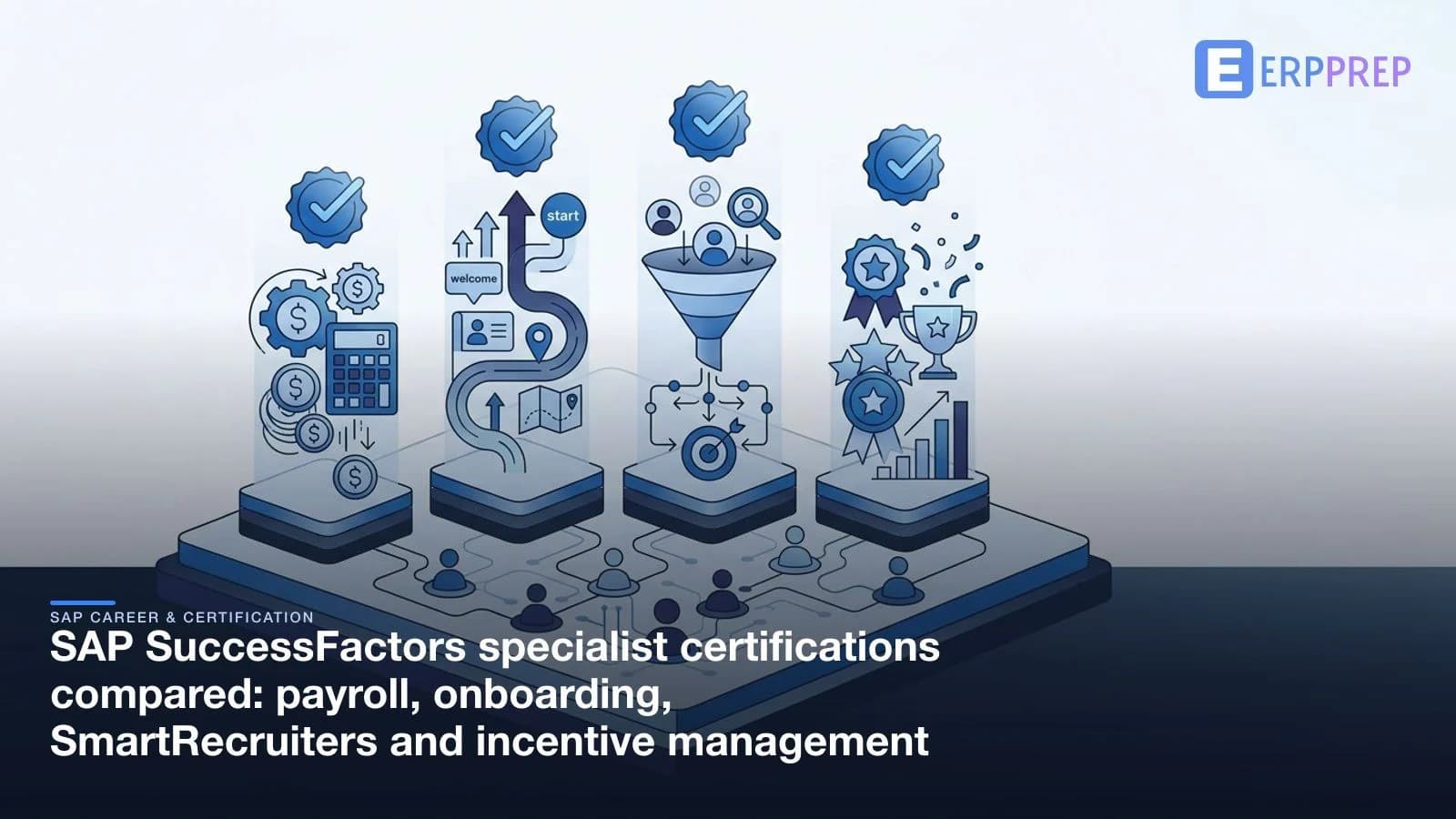
Four SAP SuccessFactors specialist certifications sit outside the core talent modules: C_HRHPC (Employee Central Payroll), C_THR97 (Onboarding), C_THR104 (SmartRecruiters) and C_THR70 (Incentive Management). All four are associate-level Scenario-Based Assessments with a 60% cut score, but each attaches to a different operational system — payroll, hiring, recruiting or sales compensation. That anchor, not the SuccessFactors label, drives who hires you.
Most SAP® SuccessFactors guidance stops at the core: Employee Central, then the talent modules. But four certifications sit deliberately outside that cluster — Employee Central Payroll, Onboarding, SmartRecruiters and Incentive Management — and they behave differently in a career, because each one plugs into a different operational system rather than a talent process. They are easy to overlook precisely because the standard SuccessFactors comparison never reaches them, yet for the right person a specialist edge is a faster, less crowded route into consulting than another pass at the core. For the wider "is certification worth it" question, start with whether SAP certification is worth it and which to choose.
Four SuccessFactors specialist certifications sit outside the core talent modules: C_HRHPC (Employee Central Payroll), C_THR97 (Onboarding), C_THR104 (SmartRecruiters) and C_THR70 (Incentive Management). All four are associate-level Scenario-Based Assessments with a 60% cut score, but each attaches to a different operational system — payroll, hiring, recruiting or sales compensation. That anchor, not the SuccessFactors label, drives who hires you.
Key takeaways
- These are edges, not tiers. None of the four is a harder version of a talent module — they certify adjacent systems that happen to live in, or connect to, the SuccessFactors landscape.
- The format is consistent. All four are Scenario-Based Assessments centred on one activity, each with a 60% cut score.
- The effort is not. The payroll journey is roughly twice the length of the onboarding journey, across three recommended courses instead of two.
- Two run on the platform, two run on an engine. Onboarding and SmartRecruiters begin with platform configuration; payroll and incentive management begin with a calculation engine.
- Access rules bite hardest here. Onboarding restricts provisioning rights to registered partner consultants, and payroll implementation expects current credentials.
- Your background chooses for you. Finance and sales-ops profiles gravitate to incentive management, HR-operations profiles to onboarding, and pay-cycle owners to payroll — because each edge rewards a different instinct.
Which SuccessFactors certifications sit outside the core modules?
Each of these credentials sits on its own official learning journey (SAP, learning.sap.com). Side by side, the shape of the family becomes obvious:
| Exam | What it anchors to | Journey weight | Best for |
|---|---|---|---|
| C_HRHPC | Cloud payroll engine fed by Employee Central | 3 courses, ~24 hours | Payroll consultants and operations teams |
| C_THR97 | New-hire, rehire and offboarding process layer | 2 courses, ~11 hours | Partner consultants delivering hiring processes |
| C_THR104 | Recruiting front end acquired into the suite | 2 courses, ~16 hours | Talent-acquisition and career-site specialists |
| C_THR70 | Sales-compensation calculation and analytics | 1 course, ~12 hours | Compensation, sales-ops and analytics profiles |
One structural detail is worth pausing on. The onboarding and SmartRecruiters journeys both open with the SuccessFactors platform academy — permissions, the Metadata Framework, business rules, picklists, the data model. The payroll and incentive journeys do not. They start inside their own engines instead. That single difference tells you more about the daily work than any exam description will: two of these certifications assume you configure through the platform, and two assume you operate a specialised engine that the platform merely surrounds.
Never sat a scenario-style SAP exam? All four of these are reason-through-a-situation assessments rather than recall tests, so it is worth feeling the format before you commit a study plan — try a free sample.
The four specialist exams at a glance
The table above sorts the family by what each credential anchors to. This one lines up the exam mechanics, so you can see how uniform the format is even though the subject matter and effort vary widely. Read it as confirmation that the choice between these four is a choice of domain, not a choice of difficulty level.
| Exam | Module / system | Format | Cut score | Tier | Best suited to |
|---|---|---|---|---|---|
| C_HRHPC | Employee Central Payroll | Scenario-Based, 1 activity | 60% | Associate, intermediate level | Pay-cycle owners and payroll consultants |
| C_THR97 | SuccessFactors Onboarding | Scenario-Based, 1 activity | 60% | Associate, intermediate level | Process and integration consultants |
| C_THR104 | SmartRecruiters for SuccessFactors | Scenario-Based, 1 activity | 60% | Associate, intermediate level | Talent-acquisition specialists |
| C_THR70 | SAP Incentive Management | Scenario-Based, 1 activity | 60% | Associate, intermediate level | Compensation and analytics profiles |
Two caveats keep this honest. First, tier language: these are entry-level consultant credentials that certify you to contribute to a project team in a mentored role, not senior architecture badges — "specialist" here describes the narrow subject, not seniority. Second, only Incentive Management published a language (English) on its card at the time of writing; the other three did not show one, and SAP flagged a newer Onboarding version, so always confirm the live details before booking.
Specialist versus associate: what is actually different?
It is tempting to read "specialist" as a rung above the core associate SuccessFactors exams. That is not how these four behave. They share the same tier, the same Scenario-Based format and the same 60% cut score as the core talent credentials. What differs is scope. A core associate exam such as the Employee Central or performance-and-goals credential covers a whole talent process that most HR systems run. A specialist exam narrows onto one operational system that only some organisations deploy — a cloud payroll engine, an onboarding process layer, an acquired recruiting product, or a sales-compensation calculator.
That narrowing changes the value proposition in a way that is easy to miss. Because fewer employers run each specialist system, and fewer consultants bother to certify on it, the credential signals scarcer knowledge even though the exam is no harder to pass. It also changes who you work alongside: incentive management pulls you toward sales operations and finance, payroll toward controllers and pay teams, onboarding toward the seam where recruiting hands off to HR, and SmartRecruiters toward talent-acquisition. The core exams keep you inside the HR function; the specialist edges routinely take you outside it. If you are still deciding between the core modules first, the core SuccessFactors comparison is the better starting point, and the talent-cluster comparison maps the neighbours these four sit beside.
What does the Employee Central Payroll certification cover?
C_HRHPC is the heaviest of the four. It certifies the payroll engine that Employee Central feeds, and its journey moves through three distinct bodies of work: administering payroll day to day, wiring the integration between Employee Central and the payroll system, and configuring the Payroll Control Center itself. That three-part shape is why the journey runs to roughly twice the length of the onboarding one — it asks you to be comfortable as an administrator, an integration consultant and a control-centre configurator, not just one of the three.
In practice that means validating replicated employee data, maintaining the extra payroll attributes that events demand, grouping policies and teams for a payroll cycle, running and monitoring production payroll, resolving the alerts a run throws up, and then closing the loop — posting results to financial accounting, pushing bank transfers, handling off-cycle payments and auditing what happened. Newer material also covers assistants and AI features arriving in payroll operations, alongside best-practice configuration and the roles and authorisations that govern who can run a cycle. Read the journey as a whole and the emphasis is unmistakable: this is precision work on a deadline, where a mistake is visible in someone's pay packet.
The Employee Central foundation matters here more than for any of the other three. Payroll does not hold its own master data — it consumes what Employee Central replicates, so a large part of the skill is trusting, checking and troubleshooting that hand-off rather than keying data yourself. That is exactly why a full recommended course is devoted to the integration alone. Its page adds a gate worth knowing about early: consultants who implement this solution are expected to hold current credentials. If your interest is on-premise payroll instead, that is a different exam and a different decision.
Who is the SuccessFactors Onboarding certification for?
C_THR97 certifies the process layer that carries a person from accepted offer to productive employee — and, at the other end, out again. The journey covers activating the module, permissions for consultants, hiring managers and new hires, the onboarding data model, building programs and their tasks, compliance forms, custom objects for extra data collection, document templates with electronic signature, email services and tokens, rehire checks, cancellations and no-shows, process variants, internal hires, restarts, offboarding and an alumni experience. It is a broad catalogue of small, configurable steps rather than one deep engine, which is why the module rewards people who enjoy assembling a clean end-to-end process out of many moving parts.
The defining feature, though, is connectivity. An unusually large part of the scope is integration: back into recruiting, across to SmartRecruiters and learning, down into Employee Central, and outward to external HR systems and applicant-tracking tools, plus identity services and the wider work-zone experience. Onboarding is where the suite's seams show, which is exactly why it rewards consultants who think in interfaces — the value you add is often in making two systems hand a new hire cleanly to each other, not in any single screen. It is also the natural companion to the core recruiting credential, because the two share a boundary that a new hire crosses.
Two practical notes shape the decision. First, eligibility: provisioning rights go only to registered SAP partner consultants once certified, with customers and independent consultants excluded even when certified and no exceptions to the policy — so if you are not inside a partner firm, weigh what the certificate actually unlocks for you before investing. Second, timing: the page signposted a newer version of the exam, so check the live card before booking rather than preparing against details that may have moved.
How is SmartRecruiters different from SuccessFactors Recruiting?
C_THR104 is the odd one out, and deliberately so. SmartRecruiters is a recruiting product brought into the SAP portfolio rather than one grown inside it, so the certification covers a system with its own dashboard, its own marketplace and its own vocabulary — while still expecting you to know the SuccessFactors platform underneath. That dual heritage is the whole point of the exam: you are learning a distinct product and the platform that now hosts it at the same time, which is why the journey pairs a SmartRecruiters academy with the shared platform course.
The scope is the full hiring funnel: job templates, organisation fields and their dependencies, locations, pay-transparency fields and approval flows; advertising, agency partnerships and their portals, employee referrals, career-site brands and pages; the application experience, screening questions in several flavours including branching logic, and custom forms; interview types, templates, scheduling automation and scorecards; hiring workflows, rejection paths, offer templates and clauses with electronic signature; email, SMS and campaign communications; an AI chatbot and matching layer; and global consent and compliance settings. Laid out like that, the exam is less about HR records and more about running a modern recruiting marketing machine — sourcing, candidate experience and pipeline conversion.
The distinction from the core recruiting module is worth stating plainly. SuccessFactors Recruiting is the suite's home-grown hiring solution; SmartRecruiters is an acquired front end with candidate-relationship management at its heart. If your day is candidate pipelines, career sites and offer management rather than employee records, this is the closest fit — and it sits beside the recruiting option discussed in the core SuccessFactors comparison.
What does SAP Incentive Management certify?
C_THR70 is barely an HR exam at all in feel. It confirms that you can implement compensation plans — and the journey is a rules-and-calculation curriculum: security structures and processing units, data loading, organisation and classification data, territories, fixed values, rate tables, lookup tables, formulas and variables, then the four rule types that build a plan (credit, measurement, incentive and deposit). After that comes the calculation pipeline itself, reviewing results, manual entries and modelling, then payee communication, disputes and inquiries, dashboards, published reports and embedded analytics stories.
Read that list as a job description and it looks less like talent management and more like a configurable calculation engine with a reporting layer on top. The mental model that helps is a spreadsheet grown into an enterprise system: you define how credit is earned, how it is measured, how an incentive is derived and where it is deposited, then run a pipeline and defend the numbers when a salesperson queries them. That is why it often attracts people from sales operations, finance and analytics rather than HR — the skills that transfer are logic, data handling and a tolerance for reconciliation, not people-process design.
It is also the one specialist exam that lists English on its card and runs on a single recommended course, which makes it the tightest, most self-contained journey of the four despite the density of what it teaches. And it is why the credential is stranded from the talent-cluster comparison most guides stop at — the work simply lives in a different part of the business.
Which specialist certification fits your role?
Because each exam anchors to a different system, the cleanest way to choose is to match the credential to where you already work — or where you want to move. The table below reads the family from the role inward rather than from the exam outward.
| If your role or background is… | Lean toward | Because |
|---|---|---|
| Payroll operations or a pay-cycle owner | C_HRHPC | It certifies running, monitoring and closing real payroll on a deadline, plus the Employee Central integration that feeds it. |
| Process design or integration consulting | C_THR97 | Onboarding is dominated by interfaces between recruiting, learning, Employee Central and external systems — a home for interface thinkers. |
| Talent acquisition or an ATS background | C_THR104 | SmartRecruiters covers the whole hiring funnel and candidate-relationship management, reusing sourcing and pipeline instincts you already have. |
| Finance, sales operations or analytics | C_THR70 | Incentive Management is a rules-and-calculation engine — logic, rate tables and formulas transfer straight across from those functions. |
If two rows describe you, let the practical constraints decide. Onboarding's partner-only provisioning rule favours anyone already inside a partner firm; payroll's expectation of current credentials favours consultants who intend to implement rather than advise; and the sheer length of the payroll journey is a real cost if your time is limited. When your background and your constraints point at the same exam, that is your answer.
How should you prepare for a specialist exam?
Preparation for these four looks different from cramming a definitions list, because the format is different. Every one of them is a Scenario-Based Assessment centred on a single activity, so the exam rewards reasoning through a realistic situation — reading a set of conditions, weighing options and choosing the defensible action — rather than reciting features. A study plan built around recall will underperform one built around applied judgement. Start by mapping the official journey's course, unit and lesson structure; it is the closest thing SAP publishes to a blueprint, and the sequence of topics is a reliable guide to where the weight sits.
From there, three habits carry across all four. First, learn the anchor system on its own terms — the Payroll Control Center, the onboarding process model, the SmartRecruiters dashboard, or the incentive calculation pipeline — because each has a distinct operating logic that scenario questions probe. Second, practise the dependency chains: which configuration step enables which downstream behaviour, and what breaks when it is missing. Third, rehearse under the scenario format itself, so that reading a dense situation and selecting the best response feels routine before exam day. That single transferable skill — reasoning through a performance-based exam — is the one worth building deliberately, because it carries across every specialist edge of the suite. Working a handful of realistic practice scenarios end to end is the fastest way to internalise it.
Why do the specialist tracks often pay differently?
We do not publish pay figures, and any single number you see quoted for an SAP certification is usually a market average dressed up as a promise. But you can reason about the mechanics honestly, and four of them apply here:
- Smaller pools. Far more consultants certify on core HR than on payroll or incentive calculation, so specialist supply is thinner in most markets.
- Direct financial risk. Payroll and incentive management both move money. Work that fails visibly and expensively tends to be resourced differently from work that fails quietly.
- Gated access. Where provisioning rights are limited to registered partner consultants, the credential functions as an entry key inside a partner firm, not just a line on a CV.
- Different budget owners. Incentive management is often sponsored by sales operations or finance rather than HR, which changes who is buying the skill and why.
None of that guarantees a premium. It explains why the specialist edge is a genuinely different market from the core modules — worth entering on purpose, not by accident.
How should you choose between them?
Work backwards from the system you want to own. Choose C_HRHPC if you want responsibility for a pay cycle and the discipline that comes with it. Choose C_THR97 if you enjoy process design and integration work across several products at once. Choose C_THR104 if candidate experience and hiring funnels are your centre of gravity. Choose C_THR70 if rules, formulas and calculation results are what you actually like doing.
Two practical checks before you commit. First, eligibility: confirm the partner and provisioning terms on the live certification page, because they differ across these four and they change. Second, format readiness — because every one of them is scenario-driven, the transferable skill is learning to reason through a performance-based exam, not to memorise. Build that once, and it carries across every specialist edge of the suite.
The most reliable way to test whether the scenario format suits you is to sit one before you invest weeks in any single journey — try a free ERPPrep sample and see how reasoning-through-a-situation feels in practice.
Frequently asked questions
- What are the specialist SAP SuccessFactors certifications?
- Beyond the core talent modules, SAP certifies four specialist areas: Employee Central Payroll (C_HRHPC), Onboarding (C_THR97), SmartRecruiters (C_THR104) and Incentive Management (C_THR70). Each is an associate-level consultant credential delivered as a Scenario-Based Assessment built around a single activity, with a 60% cut score. What makes them specialist is not extra difficulty but focus: instead of covering a talent cycle, each one attaches to a distinct operational system — running pay, moving new hires through onboarding, sourcing candidates, or calculating sales compensation. That anchoring system, more than the SuccessFactors brand, decides which teams recruit for the skill.
- Is C_HRHPC the same as a general SAP payroll certification?
- No. C_HRHPC certifies Employee Central Payroll — the payroll engine fed by SuccessFactors Employee Central and operated largely through the Payroll Control Center, with a journey that also covers wiring the integration between the two. It sits in the cloud HR world. A separate credential, C_HCMP, covers payroll running inside S/4HANA, which is a different technical foundation and a different day job. If you are weighing on-premise against cloud HR careers more broadly rather than picking a payroll module, that is a distinct decision, and the two credentials rarely compete for the same role.
- Do I need to be an SAP partner consultant to sit these exams?
- Anyone may study for and sit them, but access to the systems afterward is not uniform. The Onboarding certification (C_THR97) states plainly that provisioning rights are granted only to registered SAP partner consultants once they are certified, with customers and independent consultants excluded even when certified, and no exceptions to that policy. The Employee Central Payroll page separately notes that consultants who implement the solution are expected to hold valid credentials. So the exam is open, but what the certificate unlocks can depend on your employer. Confirm the live terms before booking.
- What format and cut score do the specialist exams use?
- All four are Scenario-Based Assessments built around a single activity, and each publishes a 60% cut score on its certification page. That means they reward reasoning through a situation rather than recalling isolated facts, so preparation should lean toward applied judgement. Language availability varies: Incentive Management (C_THR70) lists English on its card, while the other three did not show a language at the time of writing. SAP also signposted a newer version of the Onboarding exam, so treat any format detail as provisional and verify the current card on the exam page before you commit a study plan.
- How much study time does each learning journey take?
- The official journeys differ sharply in weight, which is a useful planning signal. Employee Central Payroll is the heaviest, spanning three recommended courses and roughly twenty-four hours of content. SmartRecruiters runs about sixteen hours across two courses. Incentive Management is around twelve hours in a single focused course. Onboarding is the lightest of the group at roughly eleven hours across two courses. All four are pitched at an intermediate experience level rather than beginner, so the hour counts assume you already understand how an HR system is administered rather than starting from zero.
- Why do the Onboarding and SmartRecruiters journeys include a platform course?
- Both journeys open with the SuccessFactors platform academy because both are configured using platform tooling — role-based permissions, the Metadata Framework, business rules, picklists and the underlying data model. You cannot set up onboarding programs or recruiting workflows without that foundation, so the journey front-loads it. Employee Central Payroll and Incentive Management skip that academy: their journeys begin inside their own engines instead, because the daily work is running pay or building calculation rules rather than administering the platform. That structural split is a genuine clue about the kind of work each certification prepares you for.
- Do specialist SuccessFactors certifications pay more than core modules?
- ERPPrep does not publish pay figures, and rates vary enormously by market, employer and experience. What is structural rather than speculative: specialist pools are smaller because far fewer consultants certify on payroll or incentive calculation than on core HR; payroll and incentive work both move money and carry direct financial risk; and partner-gated provisioning limits who can actually deliver. Those forces shape demand in ways that generalist tracks do not share. None of it guarantees a premium, so treat any specific salary figure you read elsewhere as a market average dressed up as a promise, not a personal forecast.
- Which specialist certification should a career-switcher start with?
- Work from the system you already understand rather than the SuccessFactors label. If you come from finance or sales operations, Incentive Management (C_THR70) is the most natural bridge — it is essentially a configurable calculation engine, and its journey assumes comfort with rules, rate tables and formulas. If you come from HR operations or an ATS background, Onboarding (C_THR97) or SmartRecruiters (C_THR104) reuse process and hiring instincts you already have. Payroll (C_HRHPC) suits anyone who wants ownership of a pay cycle and does not mind precision-heavy, deadline-driven work. Match the anchor system to your existing strengths.
ERPPrep is an independent platform and is not affiliated with, endorsed by, or sponsored by SAP SE. SAP and other SAP products are trademarks of SAP SE, referenced here only to describe the certification exams ERPPrep helps you prepare for.
Ready to practise the way the exam tests?
ERPPrep provides original, performance-style scenarios and skill drills built for the 2026 SyBA and SBA formats. Try a free sample and judge the quality yourself.
Practice for these exams
Related guides
SAP SuccessFactors talent modules compared: Performance & Goals vs Variable Pay vs Learning
The SuccessFactors talent cluster certifies by module. Performance & Goals (C_THR82), Variable Pay (C_THR87), and Learning (C_THR88) each cover a different slice of talent management. Here's how to pick the talent-management certification for your HR role.
The full SAP SuccessFactors certification map
SAP SuccessFactors certifies by HR module — Employee Central, Performance, Recruiting, Learning, Time, Reporting, Pay — with each cert's format and cut score.
Which SAP SuccessFactors certification should you take?
SAP SuccessFactors certifies by HR module, not one exam. Employee Central Core (C_THR81) is the data foundation; Performance & Goals (C_THR82) covers talent. Here's how to pick the SuccessFactors certification that matches your HR role.