

SAP certification vs a degree: which gets you hired?
A university degree and an SAP certification prove different things. For SAP roles specifically, a current certification plus demonstrable hands-on skill often outweighs a generic degree — but experience leads. Here is how employers actually read each.
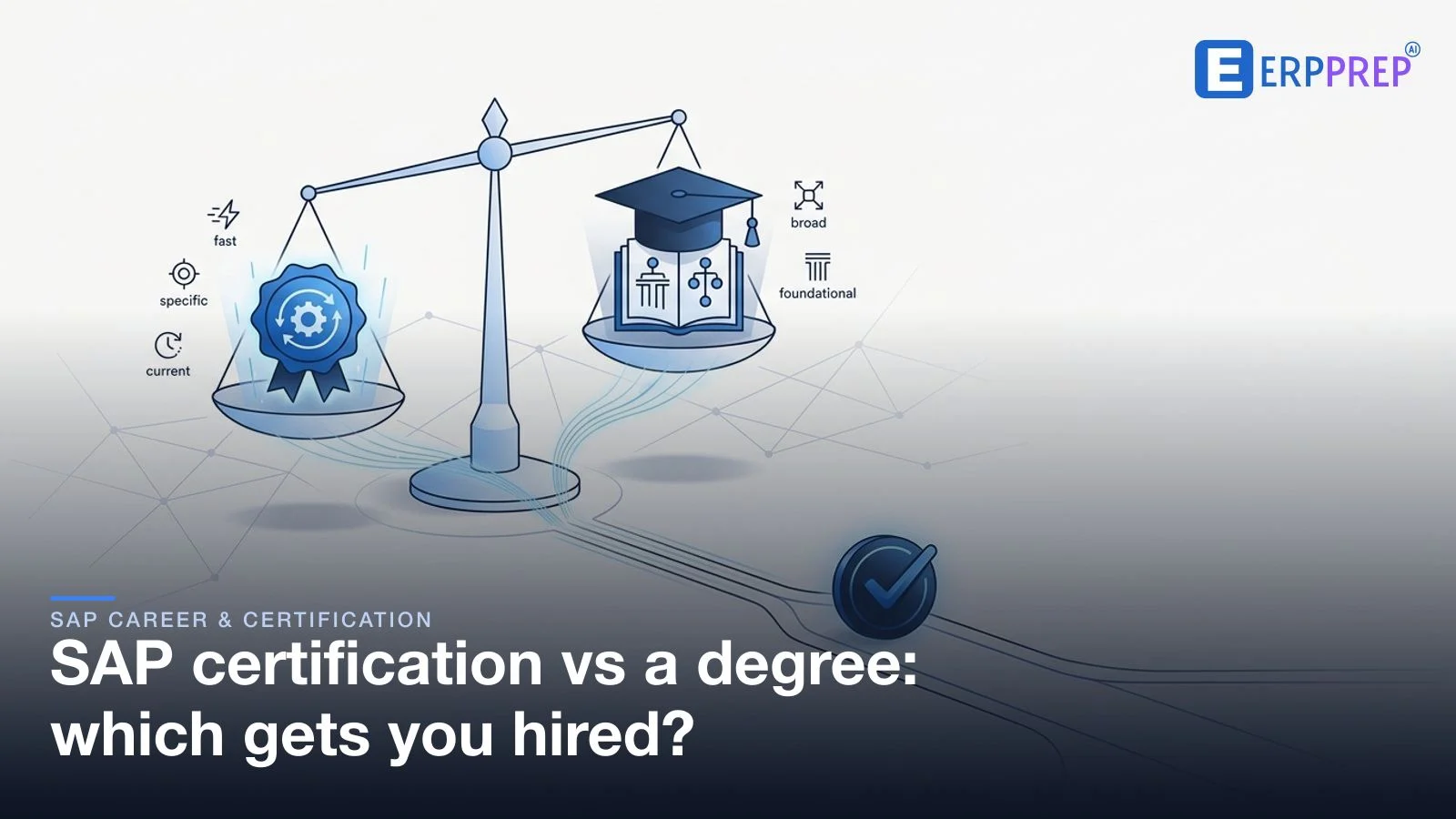
A degree and an SAP certification serve different purposes: a degree signals broad, foundational education, while an SAP certification signals current, role-specific competence in one solution. For SAP roles specifically, a current certification plus demonstrable hands-on skill often outweighs a generic degree — but real project experience still leads over both.
"Should I get a degree or an SAP® certification?" It is one of the most common questions from career switchers and sponsored learners alike, and the framing is usually wrong. The two are not competitors for the same job — they answer different questions in a hiring manager's head. This guide compares them honestly, shows how SAP employers actually weigh each, and explains where a certification wins, where a degree still wins, and whether you need both. For the wider question of whether a certification pays off at all, see whether SAP certification is worth it and how to choose.
Key takeaways
- A degree and an SAP certification are not substitutes — one proves broad foundation, the other proves current, role-specific skill.
- For SAP-specific roles, a current certification plus hands-on fluency often reads as the stronger signal than a generic, unrelated degree.
- Experience leads over both. A qualification opens the door; demonstrable skill wins the interview.
- A degree still wins on breadth and is sometimes a hard gate — graduate schemes, some employers, and certain visa routes require one.
- SAP certifications reward currency: the 2026 exams are performance-based and you keep the credential current as products evolve.
SAP certification vs university degree, side by side
Before the nuance, here is the plain comparison across the dimensions candidates ask about most. Neither column is "better" — read it as two different tools for two different jobs.
| Dimension | SAP certification | University degree |
|---|---|---|
| Time to earn | Weeks to a few months of focused prep per exam | Typically three to four years of full-time study |
| Cost (qualitative) | A targeted, comparatively modest one-off outlay per exam | A major, multi-year investment of money and time |
| What it proves | Current, role-specific competence in one SAP solution | Broad foundational education and sustained academic discipline |
| How employers read it | "Can do this SAP work now" — a direct role signal | "Educated, trainable" — a general capability signal |
| Currency / recency | Reflects today's release; kept current as products evolve | Does not expire, but can date as technology moves on |
| Best for | Entering or advancing in a specific SAP role, fast | Broad optionality and roles that formally gate on a degree |
What a university degree gives you
A degree is a breadth-and-foundation signal. Over several years it builds general reasoning, written communication, and the habit of working through hard material independently — capabilities that transfer across almost any role. It is also, in practical terms, a filter: some graduate programmes, larger employers, and certain work-visa routes still ask for a degree as a baseline before they will consider a candidate at all. That gatekeeping function is real, and it is the single strongest reason a degree keeps its value even in a field like SAP where skill can be demonstrated directly.
What a degree does not do is prove you can configure a specific SAP module. A finance or computer-science degree tells an employer you can learn; it says little about whether you can post a document, model an organisational structure, or reason through a connected business scenario in S/4HANA. That gap is exactly what a certification is built to close.
What an SAP certification gives you
An SAP certification is a depth-and-currency signal. It maps to one solution area and says, in effect, "this person can do this kind of SAP work, on today's release." Because SAP's 2026 exams are largely performance-based — System-Based Assessment (SyBA) tasks in a live system and Scenario-Based Assessment (SBA) work through a connected business case — passing one increasingly implies you can perform, not just recall. That is a meaningfully different claim from a multiple-choice quiz, and it is why a recent certification reads as a stronger competence signal than it did a few years ago.
The trade-off is scope. A certification proves one thing well and says nothing about the rest. It is a spotlight, not a floodlight — which is precisely what makes it efficient when the role you want is well defined. To understand what the format actually measures, see how the performance-based exams test you.
How SAP employers actually weigh them
In the real hiring funnel, the order of priority for an SAP role is usually: relevant experience first, then demonstrable skill, then credentials (certification and/or degree) as supporting evidence. A candidate who has configured and supported real SAP processes will nearly always be more credible than one carrying only a qualification — degree or certification.
But most people asking this question do not yet have experience, and that changes the calculus. When two candidates both lack a track record, the one with a current, role-relevant certification plus visible hands-on practice looks more ready to contribute than the one with an unrelated degree and nothing SAP-specific. For an SAP job, the certification speaks the language of the role; a generic degree does not. This is why, for SAP positions specifically, a targeted certification often outweighs a generic degree at the shortlist stage — a pattern explored further in does SAP certification help you get hired.
Want to see what "demonstrable skill" looks like? A free sample shows the performance-based, doing-over-recalling style employers increasingly hire for. Try a free sample.
Where certification wins: speed, specificity, currency
A certification beats a degree on three axes that matter enormously to anyone trying to enter or move within SAP quickly:
- Speed. You can prepare for and pass a single exam in weeks to months, not years. For a career switcher who already has a degree and domain knowledge, this is the difference between a plan measured in a term and one measured in a decade — see the career-switcher path into SAP.
- Specificity. A certification maps to a role. If you want to work in finance on S/4HANA, the finance consultant path and its lead exam say exactly that — a precision a broad degree cannot match.
- Currency. Because SAP is moving toward keeping certifications current as releases change, a recent credential signals that you know today's product. A degree earned years ago carries no such freshness — see whether SAP certifications expire.
Where a degree still wins: breadth and gatekeeping
It would be dishonest to pretend a certification does everything. A degree keeps two durable advantages. The first is breadth: the general education, communication, and problem-solving a multi-year programme builds transfer across roles and hold up when you change fields entirely. A certification is deliberately narrow; a degree is deliberately broad, and there are careers — and life stages — where breadth is the better bet.
The second is gatekeeping. Some employers, most structured graduate schemes, and a number of skilled-work immigration routes treat a degree as a non-negotiable baseline. In those cases no certification, however strong, substitutes for the credential the process demands. If any of your target roles or destinations gate on a degree, that constraint should shape your plan before any exam does.
Do you actually need both?
For many people the honest answer is: it depends on where you are starting. Three common situations:
- You already have a degree. Then the marginal value of a second degree is usually low, and a targeted SAP certification is the efficient next step to signal role-readiness. This is the classic career-switcher position, and certification is doing the heavy lifting.
- You have no degree and time is short. A certification plus hands-on practice can get you into SAP work where a degree is not a hard gate. Keep an eye on which target roles or countries require one, and plan around that.
- You are early with time and means. A degree for foundationthen a certification for currency gives the widest optionality — breadth and role-specific proof, in sequence.
Whichever situation fits, the certification's job is the same: convert study into a credible, current claim about what you can do. If you are still deciding which exam serves that claim, start with which SAP certification to get first and the best module for beginners.
How an SAP certification compares to other IT certifications
SAP certifications are not the only credentials in an IT career, and it helps to see where they sit. Broad, vendor-neutral or platform certifications — in cloud infrastructure, networking, or project management — certify a wider or more transferable skill that spans many employers and tools. An SAP certification is the opposite kind of signal: role- and solution-specific, tied to particular modules, and (in 2026) performance-based rather than pure multiple-choice.
The practical implication is about fit, not ranking. For an SAP-specific job, the SAP credential speaks most directly to what the work requires; a broad IT certification is supporting context. For a role that is not tied to SAP, the reverse is true. Many strong consultants stack both over time — a broad platform or methodology credential alongside a deep SAP one — a strategy covered in building a second-certification stack. The discipline is to match the credential to the role, not to collect the most letters.
Turning the credential into an offer
A degree and an SAP certification are both inputs; a job is the output, and neither input converts on its own. What turns either into an offer is demonstrable skill — the ability to do the SAP work the certification names. Because the 2026 exams reward doing over recalling, the same practice that prepares you to pass also builds the portfolio that wins the interview. Practise configuring realistic scenarios, trace whole processes end to end, and rehearse under time pressure so accuracy holds. Then let the certification confirm what your practice already proves.
To go deeper on the surrounding decisions, see is an SAP certification worth it, how to prepare for an SAP certification, and what an SAP consultant actually does — and when you are ready to feel the format for yourself, the free sample is the fastest way to see whether this is work you want to do.
Frequently asked questions
- Is an SAP certification better than a degree?
- Neither is universally better — they prove different things. A degree signals broad, foundational education and is sometimes a hiring gate for graduate schemes or visa-sponsored roles. An SAP certification signals current, role-specific competence in one solution area. For SAP-specific positions, a current certification plus hands-on skill is often the more decisive signal; for the broadest career optionality, having both helps.
- Do you need a university degree to work in SAP?
- Not always. Many SAP consultants come from non-computing backgrounds — finance, supply chain, HR — and move into SAP through domain knowledge plus certification and hands-on practice. Some employers, graduate programmes, or work-visa routes do require a degree, so it depends on the specific role and country. Where a degree is not a hard gate, demonstrable SAP skill tends to carry the interview.
- Will an SAP certification alone get me hired?
- Rarely on its own. A certification opens doors and passes keyword filters, but SAP hiring — especially with the 2026 performance-based exam formats — increasingly rewards people who can actually do the work. Pair the certification with hands-on practice, a portfolio of configured scenarios, and clear domain knowledge, and it becomes a strong signal rather than just a line on a CV.
- Which matters more to SAP employers: a degree or experience?
- Experience almost always leads. A candidate who has configured and supported real SAP processes is more credible than one with only a qualification, whether that qualification is a degree or a certification. For candidates without experience, a current certification plus demonstrable hands-on practice is the fastest way to signal readiness and start building that track record.
- How is an SAP certification different from other IT certifications?
- SAP certifications are role-based and tied to specific solutions and modules, and the 2026 exams are largely performance-based rather than pure multiple-choice. Broader IT certifications — cloud platforms, networking, or project management — certify a wider or vendor-neutral skill. They can complement an SAP certification, but for an SAP-specific role the SAP credential speaks most directly to what the job needs.
- Should I get a degree or an SAP certification first?
- If you are early and have the time and means, a degree gives breadth and can unlock roles that gate on it. If you are switching careers or already have a degree, an SAP certification is usually the faster, more targeted way into SAP work because it maps directly to a role. Many people do both in sequence: the degree for foundation, the certification for role-specific currency.
- Does an SAP certification expire the way a degree does not?
- A degree does not expire, but SAP has been moving toward a staying-current model, and SAP certifications are increasingly something you keep current as products evolve rather than a permanent credential. That is a feature for employers: a recent certification signals current knowledge of today's SAP release, which a degree earned years ago cannot.
- Can an SAP certification replace a degree on my CV?
- It can substitute for the role-specific signal a degree might otherwise carry, and for many SAP consulting roles it is the more relevant credential. It does not replace a degree where one is a formal requirement — some employers, graduate schemes, or immigration routes still ask for one. Treat them as complementary: the certification proves you can do the SAP work now, the degree proves broad foundation.
ERPPrep is an independent platform and is not affiliated with, endorsed by, or sponsored by SAP SE. SAP and other SAP products are trademarks of SAP SE, referenced here only to describe the certification exams ERPPrep helps you prepare for.
Ready to practise the way the exam tests?
ERPPrep provides original, performance-style scenarios and skill drills built for the 2026 SyBA and SBA formats. Try a free sample and judge the quality yourself.
Practice for these exams
Related guides
Does SAP certification actually help you get hired?
Does SAP certification help you get hired? Yes — it clears partner mandates and recruiter screens. But experience drives pay. An honest, sourced look.
SAP certification vs experience: what matters more?
Certification or experience for an SAP career? Both matter, at different stages — how employers weigh them by seniority, and how to build both.
What jobs can you get with an SAP certification?
The roles an SAP certification opens, mapped by track — functional consultant, developer, analytics, security, project manager, and architect — with realistic job titles.