

What is an SAP Learning Journey (and how to use one to get certified)?
An SAP Learning Journey is SAP's official structured learning path toward a role and its certification. Here's how a journey is built, how it maps to the exam, free vs subscription access, and where to add hands-on, performance-based practice.
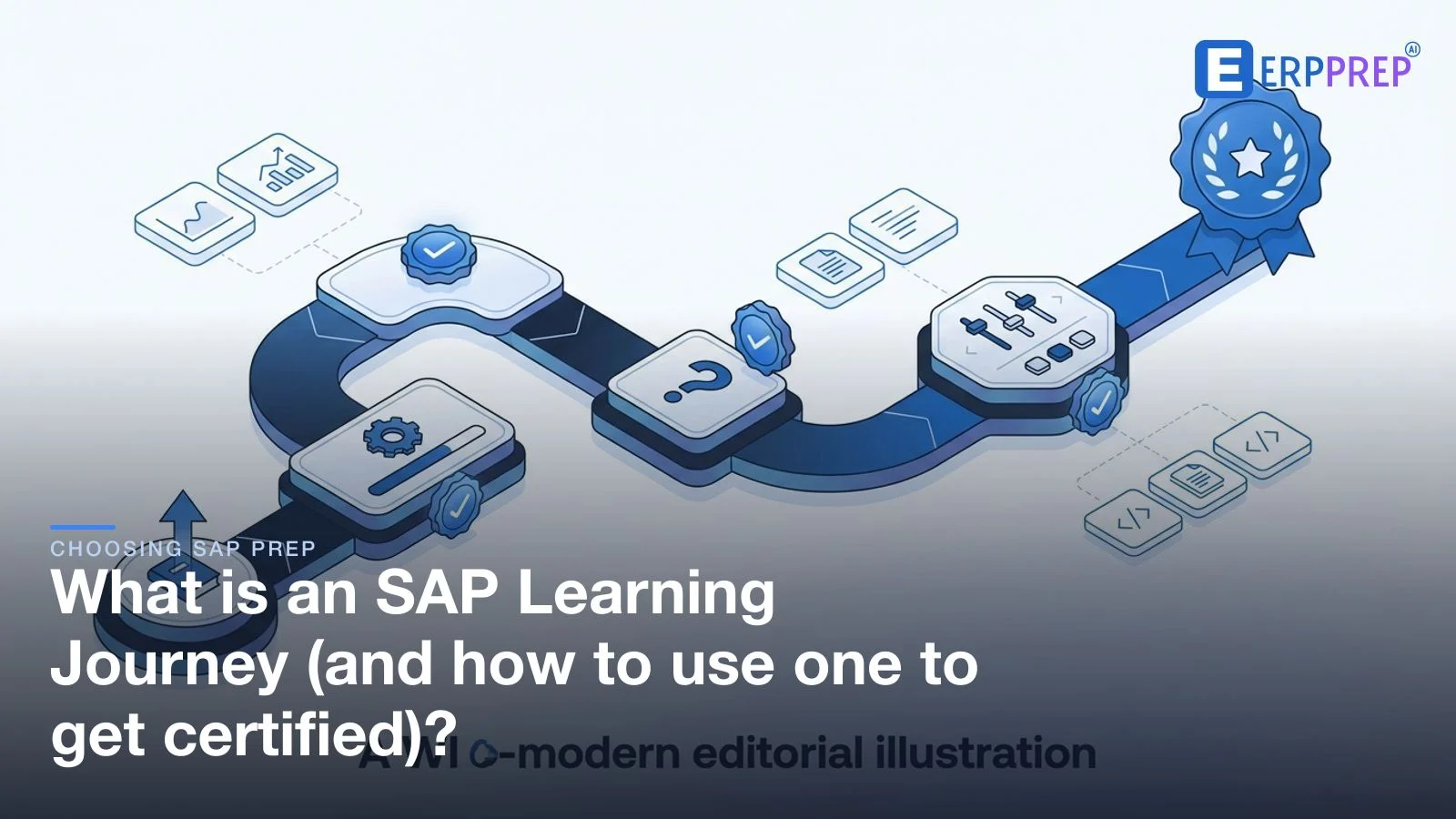
An SAP Learning Journey is a structured learning path on SAP's official learning site that guides you, step by step, through the knowledge for a specific role and its certification. It bundles ordered courses, units, hands-on exercises, and knowledge checks, and links to the matching exam. It gives you the syllabus and sequence; you still add real practice to be exam-ready.
If you have started looking into an SAP® certification, you have almost certainly run into the phrase "learning journey" on SAP's official learning site — and it is easy to mistake it for the certification itself, or for a single course. It is neither. A learning journey is a structured path: an ordered route through the knowledge and skills for one role, ending at one exam. Understanding how a journey is built, and what it does and does not do for you, is one of the highest-leverage things you can sort out before you spend a single study hour. This guide sits under our how to prepare for SAP certification hub and explains the journey in plain terms.
Key takeaways
- A learning journey is SAP's recommended study route toward one certification — not the exam, and not a single course.
- Its course-and-unit outline mirrors the exam's topic areas, so it doubles as a syllabus checklist you can track against.
- Access is tiered: reading-style content is often browsable at no cost, while hands-on practice and the exam itself typically sit behind a subscription or booking.
- The journey builds knowledge and some task fluency, but the 2026 exams are performance-based — you still need format-faithful practice under time pressure.
- Work it in order, doing every exercise, use the knowledge checks as diagnostics, and treat any specifics as deferred to SAP's official learning site, which changes over time.
Anatomy of a learning journey
Every journey is assembled from the same handful of building blocks. Once you can see those blocks, any journey — for finance, logistics, HR, development, or analytics — reads the same way. Here is what each element is and how to actually use it:
| Element | What it is | How to use it |
|---|---|---|
| The structured path | The ordered end-to-end sequence for one role and its exam — the spine everything else hangs from. | Read the whole outline first; it is your syllabus and your progress tracker, not just a starting menu. |
| Courses & units | The path broken into topic courses, each split into smaller units of reading and guided walkthroughs. | Work in sequence — later units assume earlier ones. Tick off units against the exam's topic areas as you go. |
| Hands-on / system practice | Guided exercises in a live or simulated environment where you perform the configuration or task yourself. | Do these, do not skim them. This is the closest the journey gets to the doing the exam actually measures. |
| Knowledge checks | Built-in questions that confirm you absorbed a unit before you move on. | Treat them as diagnostics. A weak score flags a unit to revisit and re-practise, not a box to tick and forget. |
| The linked certification | The specific exam the journey prepares you for, named as the journey's outcome. | Confirm the exam code matches your target, and cross-check the outline against the current exam page before you commit. |
What an SAP Learning Journey actually is
At its simplest, a learning journey answers the question "if I want to be certified in this role, what do I need to learn, and in what order?" SAP publishes one journey per certifiable role and arranges the material as a path rather than a loose library. That framing matters: instead of hunting through disconnected courses and guessing what the exam expects, you get a curated sequence that SAP maintains against the current syllabus.
It helps to be precise about what a journey is not. It is not the certification — that is the separate exam at the end. It is not a single course — a journey usually contains several. And it is not a fixed, frozen document — SAP revises journeys as products and exams evolve, which is exactly why this article describes the shape of a journey generally and sends you to SAP's official learning at learning.sap.com for the current catalogue, contents, and terms.
How a journey maps to a certification exam
The most useful property of a learning journey is that its structure echoes the exam's structure. An SAP certification exam is built from a published blueprint: a set of topic areas, each carrying a rough weighting for how much of the exam it drives. A journey's courses and units are generally organised around those same topic areas, which means the outline you see on the journey page is, in effect, a study-side view of the blueprint.
Use that alignment deliberately. Open the current exam page for your target — say the C_TS4FI S/4HANA Financial Accounting exam — note its topic areas and their relative weight, then map each area to the matching courses in the journey. Areas the exam weights heavily deserve more of your hands-on time; lightly weighted areas need coverage but not obsession. Because blueprints are revised periodically and can drift out of step with a journey between updates, always let the live exam page be the tie-breaker if the two ever disagree.
Free versus subscription access
Access to SAP's official learning is tiered, and understanding the tiers up front saves frustration later. In broad terms, a large amount of the reading-style journey content can typically be browsed at no cost — you can usually see the path, read units, and get a feel for the scope without paying. The features many candidates most depend on, though, tend to sit behind a paid subscription: sustained hands-on system practice in particular, and the certification exam booking, which is its own separate purchase.
Rather than treat that as a catch, treat it as a planning input. The free tier is excellent for orienting yourself, confirming the journey matches your exam, and starting the reading. The paid elements are where the hands-on depth lives. Exact inclusions and terms change, so confirm what your access level actually covers on the official site before you build a budget or a timeline around it — and note that qualitative "free versus paid" framing, not any specific figure, is all you should rely on from a third-party article like this one.
Want to feel the performance-based format first? A journey teaches the content; a sample shows you the doing-over-recalling style the exam actually scores. Try a free sample.
Where journeys are strong — and where you add practice
A learning journey is genuinely strong at three things. It gives you authoritative, current coverage of the syllabus straight from the source. It provides sequence and structure, so you are never guessing what to study next. And through its exercises it starts building task fluency rather than pure theory.
Its natural gap is exam rehearsal. The 2026 exams are performance-based — System-Based Assessment (SyBA), where you complete tasks in a live system, or Scenario-Based Assessment (SBA), where you reason through a connected business scenario. A journey's knowledge checks confirm understanding, but they are not a full dress rehearsal of exam conditions: sustained time pressure, ambiguous scenarios, and the accuracy-under-pace that decides real outcomes. That is the layer you add on top — and it is the same technique across exams, which is why our performance-based exam preparation guide treats it as a transferable skill. For a wider view of building that fluency, see hands-on SAP practice in 2026.
How to work through a journey efficiently
The candidates who get the most from a journey rarely just start at unit one and grind. A more efficient rhythm looks like this:
- Survey before you study. Read the full outline first and map it to the exam's topic areas so you know where the weight sits.
- Do the exercises, always. Passive reading is the easiest trap; the hands-on units are where readiness is actually built, so protect time for them.
- Score yourself honestly. Use the knowledge checks as diagnostics and loop back on anything below your own confidence bar, re-doing the exercise until the task is routine.
- Weight your time by the blueprint. Spend more on heavily-weighted areas and areas you are weak in; do not over-polish topics you already own.
- Finish with a rehearsal, not a re-read. When the journey is complete, switch to timed, format-faithful practice rather than passing through the reading a second time.
If you are fitting this around a job, our guides on how long preparation really takes and building a realistic 30/60/90-day plan turn this rhythm into a schedule.
Combining a journey with performance-based practice
The strongest preparation treats the journey and format-faithful practice as two halves of one plan, not as rivals. A simple sequence works well: use the journey to learn and internalise the syllabus and its hands-on tasks first, then use scenario and drill practice to rehearse and pressure-test that knowledge under exam-like conditions. The journey answers "do I understand this?"; the practice answers "can I do this correctly, at pace, when the scenario is ambiguous?"
Interleaving the two is even better than doing them strictly in series. As you finish each course, run a short block of matching practice while the material is fresh — you will surface misunderstandings early, when they are cheap to fix, instead of discovering them the week before your exam. If you are weighing where that practice should come from, our comparison of official SAP learning versus third-party options and how to choose a practice provider lay out the trade-offs without the hype.
Common misunderstandings
A few myths about learning journeys quietly cost candidates time and money. Clearing them up early keeps your plan honest:
- "Finishing the journey means I'm certified." No — the certification is a separate exam. The journey prepares you for it; it does not award it.
- "The whole thing is free." Only partly. Much reading is often browsable at no cost, but hands-on depth and the exam booking typically are not. Plan for tiered access.
- "The journey is a fixed syllabus I can screenshot once." SAP revises journeys and exams over time. Re-check the live pages rather than trusting an old copy — including this article's general description.
- "If I read every unit, I'll pass." The exams reward doing, not recalling. Reading without hands-on and timed practice leaves the exact gap the performance-based format is designed to expose.
- "Any journey will do for my exam." Journeys are role-specific. Match the journey to your exact exam code, or you will study adjacent-but-wrong material.
Worth flagging plainly: a legitimate journey is the opposite of an exam shortcut. ERPPrep does not provide, and you should not seek, so-called exam dumps or leaked real questions — they are unreliable and against SAP's rules. If that temptation has crossed your mind, read why SAP exam dumps are not safe before you go further.
Putting it together
A learning journey is the best starting point SAP gives you: an authoritative, ordered, current path from "I want this certification" to "I understand the syllabus and can do the tasks." Use it for exactly that — then add the rehearsal layer the performance-based format demands. Start from the C_TS4FI hub if finance is your target, revisit the how to prepare for SAP certification hub to place the journey inside a full plan, and when you are ready to test whether your knowledge holds under pressure, do it the way the exam does — by doing, not by reading.
Frequently asked questions
- What is an SAP Learning Journey?
- An SAP Learning Journey is a structured learning path published on SAP's official learning site that organises the knowledge for a specific role and its certification into an ordered sequence of courses, units, hands-on exercises, and knowledge checks. Each journey maps to a target exam, so it functions as both a syllabus and a study route. The exact catalogue and content change over time, so confirm the current journey on learning.sap.com.
- Is an SAP Learning Journey the same as the certification?
- No. The learning journey is the study path; the certification is the separate exam you take at the end. Completing a journey does not automatically certify you, and you can book the exam without finishing every unit. Think of the journey as SAP's recommended preparation route toward the exam, not the exam itself.
- Are SAP Learning Journeys free?
- Access is tiered. Much of the reading-style journey content can typically be browsed at no cost, while the deeper features many candidates rely on — such as hands-on system practice and the certification exam itself — usually sit behind a paid subscription or a separate booking. Because SAP updates these terms, check what is included at your access level directly on the official learning site rather than assuming.
- Can I pass an SAP exam using only the learning journey?
- It is possible for candidates who already work in the module daily, but for most people the journey alone is not enough. The 2026 exams are performance-based, so they test whether you can complete tasks and reason through scenarios, not whether you can recall pages. The journey gives you the syllabus and some hands-on exercises; format-faithful practice under time pressure closes the remaining gap.
- How does a learning journey map to the exam topics?
- A journey's course-and-unit outline is usually organised around the same topic areas the exam's blueprint weights. That makes the outline a natural checklist: you can track which areas you have covered and rehearsed against the exam's published topic weighting. Always cross-check the journey outline against the current exam page, since blueprints are revised periodically.
- How long does an SAP Learning Journey take?
- It varies widely by exam, by how much of the module you already know, and by how thoroughly you complete the hands-on exercises rather than skimming. Rather than chase a fixed number, plan around the journey's outline and your own diagnostic scores, and give the hands-on and practice phases the most time, since that is where exam readiness is actually built.
- Do I still need practice questions if I finish the journey?
- Yes, for most candidates. The journey builds knowledge and some task fluency, but it is not a full rehearsal of exam conditions. Practising with scenarios and drills that mirror the System-Based or Scenario-Based format trains pace, decision-making, and accuracy under pressure — the skills the performance-based exam actually scores.
- Where do I find the right learning journey for my exam?
- Start from your exact exam code and search for it on SAP's official learning site; the certification page typically links to the recommended journey, and the journey lists the exam as its outcome. If you are still choosing which exam to sit, decide the role and track first, then let the matching journey follow from it.
ERPPrep is an independent platform and is not affiliated with, endorsed by, or sponsored by SAP SE. SAP and other SAP products are trademarks of SAP SE, referenced here only to describe the certification exams ERPPrep helps you prepare for.
Ready to practise the way the exam tests?
ERPPrep provides original, performance-style scenarios and skill drills built for the 2026 SyBA and SBA formats. Try a free sample and judge the quality yourself.
Practice for these exams
Related guides
How to prepare for SAP certification: the legitimate options compared
Compare the legitimate ways to prepare for SAP certification in 2026 — official SAP learning, free journeys, third-party practice, courses, and self-study.
How to self-study for an SAP certification (without a bootcamp)
A practical method for preparing for an SAP certification on your own — assembling resources, building a solo plan, going hands-on, staying accountable, and rehearsing the performance-based format.
How to get hands-on SAP practice for the 2026 performance-based exams
The 2026 SAP exams test doing, not recall, so hands-on practice is no longer optional preparation — it is the preparation. Official learning access, project sandboxes, free tooling, independent scenario and drill practice and self-built environments, compared.