

SAP exam day: what to expect from booking to results
A calm, step-by-step walkthrough of SAP exam day — how booking and scheduling work, check-in and ID, online vs test-center proctoring, the performance-based exam environment (SyBA and SBA), and what happens at the end.
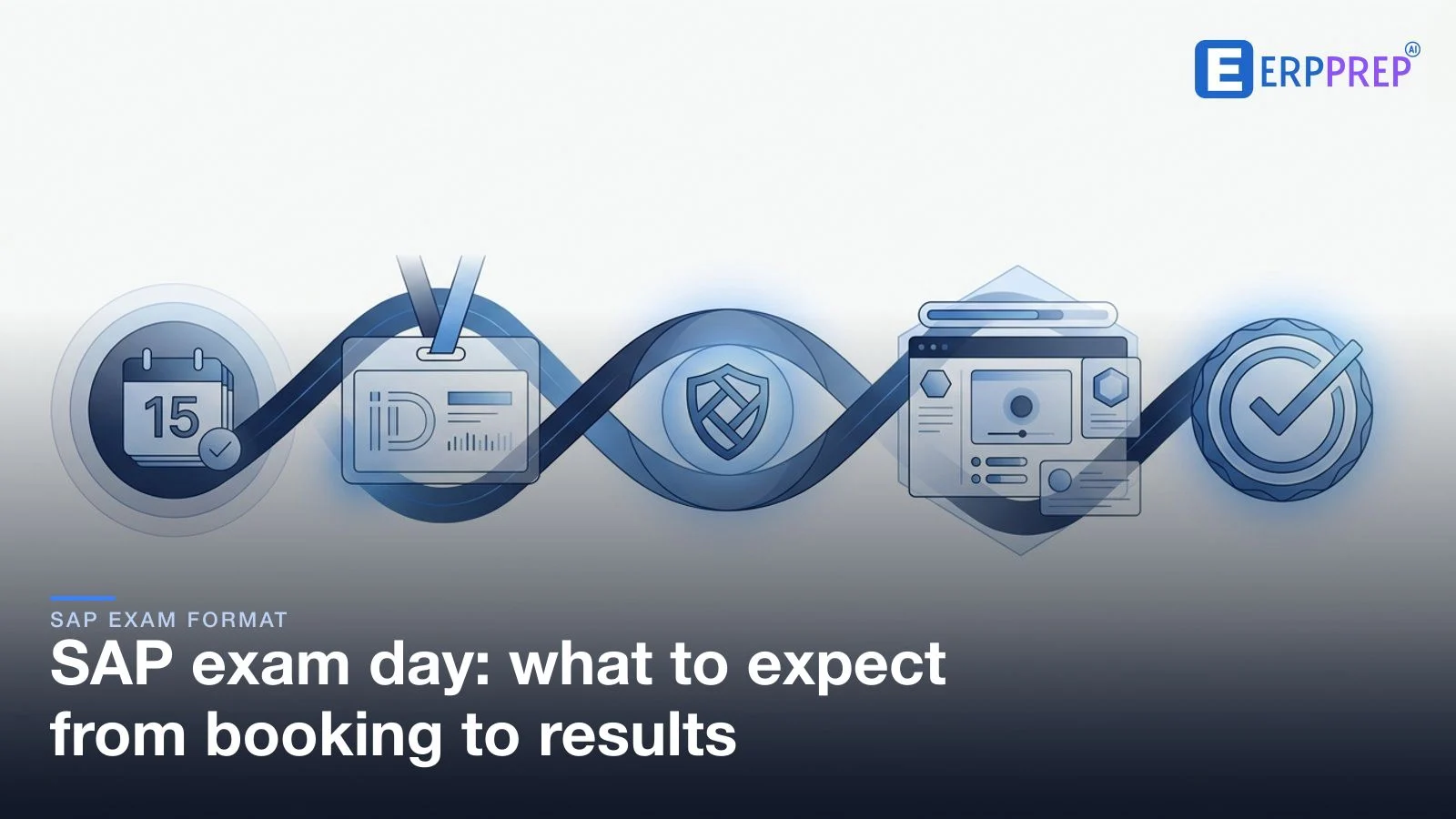
On SAP exam day you book a slot through the scheduling partner, check in and verify your identity, then take a proctored, performance-based exam — either a System-Based Assessment (SyBA) with live tasks or a Scenario-Based Assessment (SBA) built on a connected business case. You work against a timer, submit at the end, and see a pass/fail outcome. Confirm the exact rules on the exam's official page before the day.
Most of the anxiety around an SAP® certification isn't the syllabus — it's the unknowns of the day itself. Where do you book? What does check-in involve? Is someone watching? What does a performance-based exam actually look like once the timer starts? This guide walks the whole day, from reserving a slot to reading your result, so nothing on the day is a surprise. It sits under the performance-based exam format guide and stays deliberately general — every exact rule is set per exam, so we point you to the official page for the specifics.
Key takeaways
- The day has five stages — book, check in, get proctored, take the exam, and see your result — and each is more routine than it feels in advance.
- You'll choose online or a test centre; both are proctored, and each has environment rules worth reading before you commit.
- The exam itself is performance-based (SyBA tasks or an SBA scenario), so the day rewards doing over recalling.
- Identity and environment checks come first — sorting your ID and workspace in advance is the easiest way to avoid a check-in hiccup.
- Never invent the specifics. Fees, ID types, timing, and retake rules are set per exam — confirm them on the exam's official page.
Exam day at a glance
Here is the whole day in one view. The stages are the same whichever certification you sit — only the exact rules and timing differ per exam.
| Stage | What happens | How to prepare |
|---|---|---|
| Booking & scheduling | You reserve a date, time, and delivery mode through the scheduling partner linked from the exam. | Book early for a slot that suits you; read the timing and prerequisites on the exam's official page first. |
| Check-in & ID | You arrive (or log in) ahead of time and verify your identity before the timer begins. | Have an accepted photo ID whose name matches your registration ready and to hand. |
| Proctoring | A proctor supervises the session — in person at a centre or remotely by camera and screen. | Prepare a quiet, clear space (online) or plan your travel and arrival buffer (centre). |
| During the exam | You work through SyBA system tasks or an SBA connected scenario against an on-screen timer. | Rehearse the format under time pressure so pacing and navigation feel familiar. |
| Results | You submit, see a pass/fail outcome and a performance picture, and the record lands in your profile. | Know the retake and validity terms in advance so any next step is clear. |
How booking and scheduling work
You don't book an SAP exam from a single universal button — you start from the certification itself and follow its scheduling route. SAP publishes each exam, its structure, and its booking path on its learning site (SAP, learning.sap.com), and the actual seat is reserved through a scheduling partner. When you book you typically pick a date, a time, and whether you'll sit online under remote proctoring or at a physical test centre.
Two habits make this stage painless. First, book early: popular windows fill up, and giving yourself a comfortable date beats scrambling for the last available slot. Second, read the exam's own page before you commit — availability, any prerequisites, the fee, the time allowance, and the number of items are all set per exam and per region, so the reliable source is always that page rather than a general assumption. If the format itself is new to you, the 2026 exam-format change explainer covers what moved from multiple-choice to performance-based and why it matters for your prep.
Online vs test-center proctoring
Whichever mode you pick, the exam is proctored — supervised to keep it fair for everyone. The difference is where and how.
- Test centre. You travel to a supervised location and sit at a provided workstation. A person oversees the room, secure storage is usually available for personal items, and the environment is controlled for you. The trade-off is logistics: travel, arrival time, and centre availability in your area.
- Online (remote proctoring). You sit at your own computer while a proctor monitors you through your webcam and may observe your screen. It removes the travel, but the responsibility for the environment shifts to you — a suitable device, a stable connection, a quiet room, and a clear desk. Expect a workspace check before the exam starts.
Neither mode is "easier" — they test the same content the same way. Choose the one whose requirements you can meet without stress: if a reliable quiet room and connection are hard to guarantee, a centre removes that variable; if travel is the bigger obstacle, online removes that one. Read the environment and conduct rules for your chosen mode on the exam's official page so nothing about the setup catches you out.
Check-in and identity verification
The first thing that happens on the day isn't a question — it's verification. You'll be asked to prove who you are, normally with an accepted photo ID whose name matches your registration, and (online) to complete a check of your workspace before the timer starts. At a centre this is a desk formality; online it's a short guided sequence with the proctor or platform.
This stage is where avoidable problems happen, and they're almost always about ID. Acceptable document types and the exact name-matching rules vary by country and by delivery mode, so the safe move is to check the accepted documents in advance on the exam's official page and with the scheduling partner — not on the morning of the exam. Arrive or log in with a comfortable buffer so a slow check-in never eats into your thinking time. We deliberately don't list specific ID requirements here because they change; the official page is the source that stays current.
The performance-based exam environment
Once check-in is done, the exam opens — and in 2026 that means a performance-based experience rather than a page of pure recall. There are two formats, and knowing which one your exam uses shapes how the day feels:
- System-Based Assessment (SyBA). You complete tasks that resemble real configuration and operation work — setting things up, making a change, or producing an outcome that is then evaluated. It rewards genuine hands-on fluency, because you're demonstrating that you can actually do the work, not just describe it.
- Scenario-Based Assessment (SBA). You work through a connected business scenario where the pieces relate to one another, reasoning across a case rather than answering isolated facts. Later steps often build on earlier context, so following the thread matters.
In both, the on-screen environment gives you what you need to work — the task or scenario, your navigation, and a visible timer — and expects you to move through it purposefully. If you want a clear sense of what each format is really measuring before you sit, see what SyBA and SBA actually test, and for the connected-case technique specifically, SBA strategy for connected scenarios. The Finance track's C_TS4FI hub shows how one exam's content maps onto this environment.
Never sat a performance-based exam? The single best way to take the surprise out of the day is to feel the doing-over-recalling style once in advance. Try a free sample.
Managing your time on the day
Time is the resource most candidates mismanage, and it's the one you can rehearse. The exam shows the remaining time on screen; treat it as a running budget rather than a clock you glance at when it's already tight. Because performance-based tasks vary in effort, the goal is steady forward movement: give each task a fair share, and when one resists, note it, take the marks you can, and move on rather than letting a single item drain the budget for everything after it.
A few principles carry across every exam. Do a first pass that banks the work you're confident on, then return to the harder items with whatever time remains. In an SBA, read enough of the scenario to understand how the parts connect before you commit to answers, since later steps often lean on earlier context. And practise this pacing beforehand — reading about it is not the same as having felt the pressure. The dedicated guide on how to manage time on a performance-based SAP exam goes deeper on pacing tactics.
What happens at the end, and your results
When you finish, you submit the exam and the session closes. Because these exams are scored against a defined standard, you typically see a pass or fail outcome at the end of the session, along with a picture of how you performed across the exam's areas. The formal record — and any certificate or digital badge — then appears in your SAP certification profile, which is the lasting proof rather than the on-screen message.
If you don't pass, it isn't the end of the road, but there are rules. Waiting periods between attempts and limits on the number of sittings are common, and they're set per exam — so it pays to know them before your first attempt rather than discovering them when you want to rebook. The SAP exam retake policy overview explains how resits generally work, and the performance breakdown you receive is the best map of where to focus before you go again.
Common exam-day mistakes
Almost every avoidable exam-day problem falls into a short list. Knowing them is usually enough to sidestep them:
- Leaving ID and workspace to the morning. A mismatched name or a cluttered room can stall check-in. Sort both the day before.
- Assuming the rules instead of reading them. Booking, timing, ID, and retake specifics differ per exam — the official page is the source that's current.
- Never rehearsing the format. A performance-based exam feels different from multiple-choice; the first time you meet it shouldn't be the real thing.
- Over-investing in one hard task. Letting a single item consume the budget for everything after it is the classic time-management failure — see why people fail performance-based exams.
- An unreliable online setup. A shaky connection or a room you can't keep quiet adds risk; if you can't guarantee them, a centre removes the variable.
How to walk in ready
Readiness on the day is the sum of two things: the logistics being handled and the format feeling familiar. Handle the logistics in advance — book a slot that suits you, choose the delivery mode you can meet comfortably, confirm the ID and rules on the exam's official page, and prepare your space or your travel. That leaves your attention free for the exam itself.
For the format, the best preparation is to have done the doing: practise tasks in a realistic environment, trace processes end to end, and rehearse under time pressure so accuracy holds when the clock is visible. The performance-based exam preparation guide covers that technique in depth, and how to pass SAP performance-based exams ties it together. Do both, and exam day becomes what it should be — a chance to show work you've already rehearsed, not a series of surprises.
Frequently asked questions
- How do you book an SAP certification exam?
- You reserve a seat through SAP's certification scheduling process, choosing a date, a time, and whether you sit at a test centre or take the exam online under remote proctoring. Availability, any prerequisites, and the booking window differ by exam and region, so start from the exam's own page and follow its scheduling link rather than assuming a fixed process across every certification.
- Is the SAP exam online or at a test centre?
- Both delivery modes are commonly available. A test centre gives you a supervised room and a provided workstation; the online option lets you sit at your own computer under a remote proctor. Each has its own environment requirements — a suitable device and connection online, or travel and scheduling for a centre. Confirm which modes your specific exam offers and pick the one you can meet comfortably.
- What does proctoring mean for an SAP exam?
- Proctoring is supervision that protects the integrity of the exam. In a test centre a person oversees the room; online, a proctor monitors you through your webcam and may observe your screen. You are typically asked to keep your face visible, stay alone in a clear workspace, and avoid unauthorised materials. The exact conduct rules are published for each exam, so read them before the day.
- What identification do I need for the SAP exam?
- You will be asked to prove your identity at check-in, usually with an accepted photo ID whose name matches your registration. Because acceptable document types and matching rules vary by country and delivery mode, do not guess — the exam's official page and the scheduling partner list exactly what is accepted. Sorting this out in advance is the single easiest way to avoid a check-in problem.
- How long is an SAP certification exam?
- Each exam has its own time allowance and its own number of items, and performance-based tasks can take longer to work through than a quick recall question. Rather than assume a single duration, check the timing stated on your exam's page so you can plan your pacing. On the day, the remaining time is shown on screen so you can manage it as you go.
- What happens if my internet drops during an online SAP exam?
- Remote-proctored exams are built to tolerate brief interruptions, and the proctoring platform generally tries to reconnect you to the same session. The safest preparation is a stable wired connection where possible, a quiet room, and knowing the support contact in advance. If a serious technical issue occurs, follow the platform's on-screen guidance and the exam provider's stated support process.
- When do I get my SAP exam result?
- Performance-based exams are scored against a defined standard, and candidates usually see a pass or fail outcome at the end of the session along with a picture of how they performed. The formal record and any certificate then appear in your SAP certification profile. Timing and exactly what is shown can vary by exam, so treat the on-screen result as your immediate answer and the profile as the record.
- Can I retake an SAP exam if I don't pass?
- Retakes are generally possible, but they come with rules — waiting periods between attempts and limits on how many times you can sit an exam are common, and the specifics are set by SAP for each certification. Do not assume you can rebook immediately. Check the retake terms on the exam's official page before your first attempt so a resit, if you need one, holds no surprises.
ERPPrep is an independent platform and is not affiliated with, endorsed by, or sponsored by SAP SE. SAP and other SAP products are trademarks of SAP SE, referenced here only to describe the certification exams ERPPrep helps you prepare for.
Ready to practise the way the exam tests?
ERPPrep provides original, performance-style scenarios and skill drills built for the 2026 SyBA and SBA formats. Try a free sample and judge the quality yourself.
Practice for these exams
Related guides
How SAP exams prevent cheating (and why dumps don't work)
How SAP protects exam integrity — online proctoring, the performance-based SyBA/SBA format as an anti-cheat design, the certification agreement — and why exam dumps are both ineffective and risky.
SAP exam time limits: how long each format gives you
How long SAP certification exams run, how the time budget differs for SyBA system tasks versus an SBA connected scenario, why duration varies by exam, and how to find and manage your exact time limit.
Why SAP exam tasks fail: order and dependencies
In a performance-based SAP exam a task often fails on a missing prerequisite, not a missing step. How to read dependency chains and sequence your work.