

SAP certification codes explained: C_, P_, E_ and what they mean
What do SAP certification codes like C_TS4FI or P_SAPEA mean? Decode the C_, P_, and E_ prefixes, the product and module hints inside a code, and how to find the exam it names.
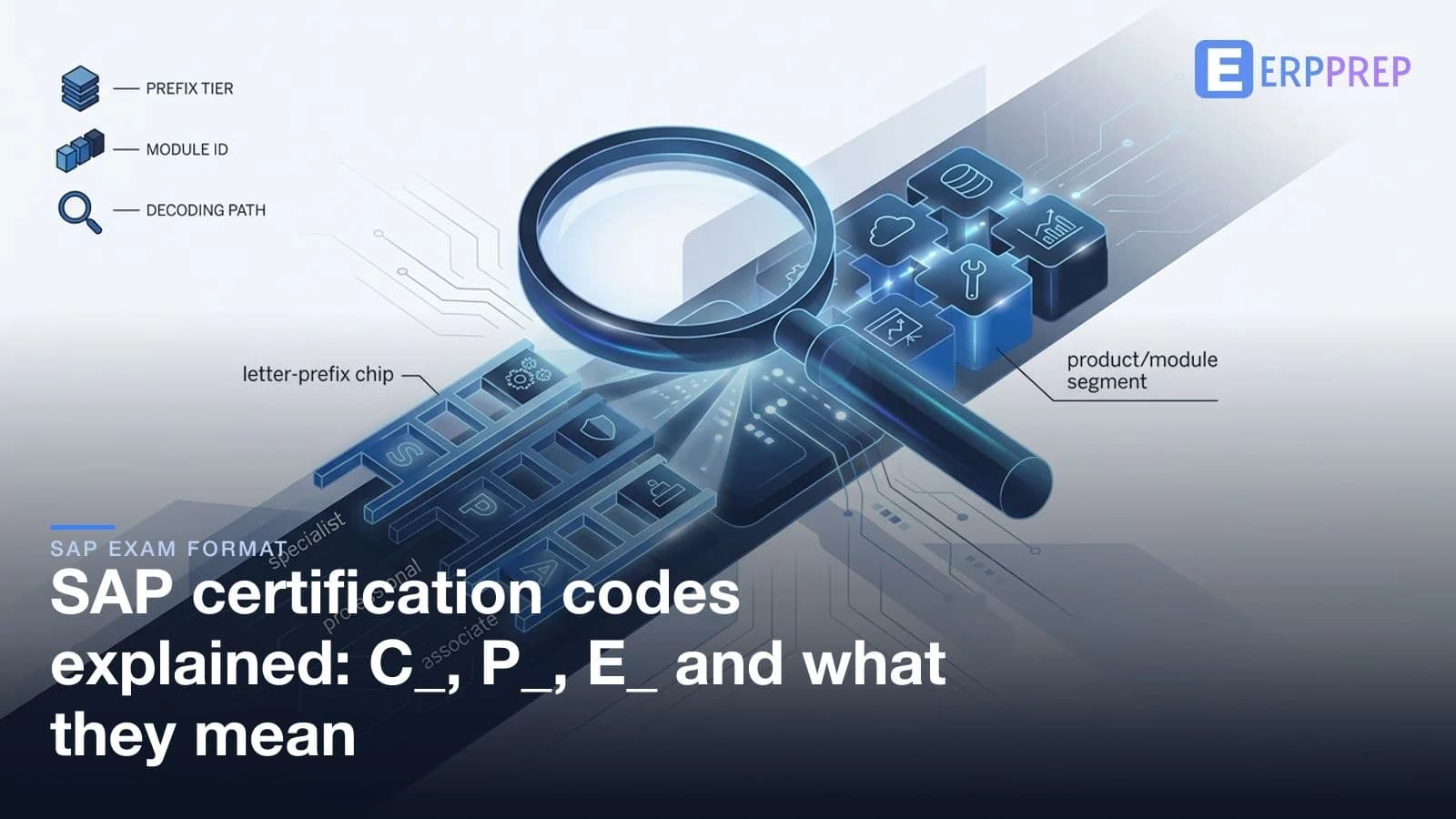
An SAP® certification code's prefix signals its tier: C_ generally marks an associate (consultant) exam, P_ a professional-level exam, and E_ a specialist exam. The characters after the underscore usually hint at the product line and module — for example TS4FI points toward S/4HANA Finance. The pattern is a guide, not a strict formula, so always confirm a specific code on its own exam page at learning.sap.com.
If you have spent any time browsing SAP® certifications, you have met codes like C_TS4FI, C_THR81, or P_SAPEA and wondered what the letters and abbreviations are actually telling you. The good news is that the codes are not random: the prefix hints at the exam's level, and the characters after it usually point at a product and a module. Learn to read that structure and you can size up an unfamiliar code in seconds instead of clicking through pages. This piece decodes the code itself; for the wider vocabulary of SAP certification, the SAP certification glossary defines the terms, and the certification levels explainer goes deep on the associate, professional, and specialist tiers.
An SAP® certification code's prefix signals its tier: C_ generally marks an associate (consultant) exam, P_ a professional-level exam, and E_ a specialist exam. The characters after the underscore usually hint at the product line and module — TS4FI, for example, points toward S/4HANA Finance. Read the pattern as a fast orientation, not a strict formula, and confirm any specific code on its own exam page at learning.sap.com.
Key takeaways
- The prefix signals the tier. C_ generally means associate, P_ professional, and E_ specialist.
- The block after the underscore hints at the product and module — often an S/4HANA or product reference plus a short functional-area abbreviation.
- It is a pattern, not a law. Abbreviations vary and conventions have changed over time, so a few codes decode less cleanly than the rule suggests.
- Use the code to orient and shortlist, then confirm the tier, product, version, and format on the exam's own page.
- learning.sap.com is the authoritative source for what any specific code actually means.
The letter prefixes (C_, P_, E_) and what tier they signal
The single most useful thing to know about an SAP certification code is its first letter, because it generally tells you the level of the exam before you read anything else.
C_ generally marks an associate exam — the consultant tier. Associate certifications certify foundational, job-ready capability in a product or module, and they make up the bulk of the catalogue, which is why most codes you encounter start with C_. When you see C_TS4FI or C_ABAPD, the C_ is telling you this is an entry point into that domain rather than a senior, experience-heavy credential.
P_ generally marks a professional exam. Professional certifications sit above the associate tier and typically assume you already have real project experience; they lean toward design, architecture, and applied judgement rather than foundational recall. P_SAPEA, the enterprise-architect exam, is a familiar example — the P_ is a hint that the exam expects seniority, not just study.
E_ generally marks a specialist exam. Specialist credentials are narrower and more focused than a full associate or professional syllabus, proving a specific capability or topic. They are often taken alongside a broader certification to signal a targeted skill. Because specialist exams vary widely in scope, the E_ is best read as "this is focused" rather than as a precise difficulty level. For the full breakdown of what each tier expects of you, the certification levels explainer covers associate, professional, and specialist in depth.
Decoding the rest of the code (product and module hints)
Once the prefix has told you the tier, the block after the underscore usually hints at what the exam is about. There is no single rigid grammar here, but a common pattern helps you read most codes: a reference to the product line, followed by a short abbreviation for the functional area or module.
Take C_TS4FI. After the C_ tier signal, the TS4 portion points toward S/4HANA, and the FI suffix reads naturally as Finance — a two-letter shorthand that has long been associated with the finance area in SAP circles. So at a glance the code says "associate-level, S/4HANA, Finance," which is exactly what it is. That is the pattern working well.
Other codes hint at their product line in different ways. In C_THR81, the HR block points toward the human-resources product family (SuccessFactors), and the digits typically map to a specific module and, sometimes, a release — which is why HR codes often carry a number where a finance code carries letters. In C_ABAPD, the ABAP block plainly signals the ABAP development area. The lesson is that the "module hint" can take the form of an abbreviation, a product acronym, or a number, depending on the family — so decode it as a clue, not a fixed field.
Want to see what an exam's questions feel like? Once a code has pointed you at the right exam, a free sample shows the performance-based style before you commit prep time. Try a free sample.
Worked examples: decode a few real codes
Putting the two halves together, here is how the reading works in practice. Notice that each decode ends the same way — with "confirm on the exam page" — because the pattern gets you oriented, not certain.
- C_TS4FI — C_ (associate) + TS4 (S/4HANA) + FI (Finance). Reads as an associate-level S/4HANA Finance certification.
- C_THR81 — C_ (associate) + HR (human-resources / SuccessFactors) + a number hinting at the specific module and release. Reads as an associate-level cloud HR certification.
- C_ABAPD — C_ (associate) + ABAP + D (development). Reads as an associate-level ABAP development certification.
- P_SAPEA — P_ (professional) + a block pointing at enterprise architecture. Reads as a professional-level architect certification that assumes experience.
Read enough codes this way and the shape becomes second nature: letter first for the tier, then the product-and-module block for the subject. But every one of these is a reading, and the next section explains why you should never treat the reading as the last word.
Why the system isn't perfectly rigid
It is tempting, once you spot the pattern, to assume there is a strict universal formula behind every code. There isn't — and believing there is will occasionally lead you astray. SAP®'s naming has evolved over many years and across many product lines, so several conventions coexist. Abbreviations are not always consistent between families; a two-letter area code in one product may look different in another; older codes and newer codes can encode the same idea differently; and a handful of codes simply do not decompose as tidily as the common pattern implies.
The practical consequence is to use the structure the way you would use a map legend — to get oriented and to shortlist quickly — while treating the exam page as the ground truth. A code can tell you "this is probably an associate S/4HANA finance exam" in a glance, and that is genuinely valuable, but only the certification's own page will confirm the exact product, the version it targets, the exam format, and the topic weighting. Say "generally" and "typically" in your own head as you decode, and you will avoid the trap of over-reading a code. Understanding the format each exam uses matters just as much as the code — how SAP's 2026 performance-based exams work explains what the letters can never tell you: whether you will be executing tasks in a system or reasoning through connected scenarios.
How to find the exam a code refers to
When you have a code and want the actual exam behind it, the fastest route is to search the exact string on learning.sap.com, where every current certification has its own page. That page is where the tier, product, version, format, and topic areas are spelled out — everything the code only hinted at.
If your code is partial or mistyped, the decoding skill still pays off: the prefix narrows the tier and the product hint narrows the family, so even "C_TS4…something…FI" is enough to find the right S/4HANA finance page. And on ERPPrep, you can look a code up directly in the exam catalogue to see whether it is one we cover and whether practice content is available for it — a quick way to connect a code you found elsewhere to something you can actually study.
Where to confirm what a code means
Whatever a code appears to say, the authoritative source is always the certification's own page. SAP publishes each exam's details — tier, product, version, format, and topic weighting — on SAP's certification catalogue at learning.sap.com, and that page supersedes any pattern-based guess. Use the code to read the room; use the page to make the decision.
That habit — decode to orient, confirm to commit — is the whole discipline in a sentence. The prefix tells you roughly how senior the exam is; the product block tells you roughly what it covers; the exam page tells you exactly. For the surrounding vocabulary, keep the SAP certification glossary and the levels explainer handy, and return to how SAP's 2026 performance-based exams work for what a code can never encode: how the exam actually tests you. Once you have pinned down the exam behind a code, the best next step is to feel its real format for yourself — try a free sample and see what that code translates to in practice.
Frequently asked questions
- What does C_ mean in an SAP certification code?
- The C_ prefix generally marks an associate-level exam — the consultant tier that certifies foundational, job-ready capability in a product or module. Most of SAP's® catalogue sits here, which is why so many codes you meet start with C_, such as C_TS4FI or C_THR81. Treat it as a strong signal of level rather than a guarantee, and confirm the tier on the exam's own page before you plan around it.
- What does P_ mean in an SAP certification code?
- The P_ prefix generally marks a professional-level exam. These sit above the associate tier and typically assume real project experience and deeper, more design- or architecture-oriented judgement rather than foundational knowledge alone. P_SAPEA is a well-known example. Because a professional exam expects applied seniority, read its page carefully for any assumed background before committing, rather than inferring difficulty from the letter alone.
- What does E_ mean in an SAP certification code?
- The E_ prefix generally marks a specialist exam — a narrower, focused credential covering a specific capability, tool, or topic rather than a full associate or professional syllabus. Specialist exams are useful for proving a targeted skill alongside a broader certification. As with every prefix, the letter is an orientation, not a rule, so confirm exactly what an E_ code covers on its learning.sap.com page.
- How do I read an SAP certification code?
- Split it at the underscore. The letter before it (C_, P_, or E_) hints at the tier; the block after it usually encodes the product line and module — for instance an S/4HANA reference plus a two-letter functional area. Read it as a set of hints that get you oriented quickly, then verify the exact product, version, and scope on the exam page rather than assuming the letters are exhaustive.
- What is the difference between associate, professional, and specialist?
- Associate (often C_) certifies foundational, job-ready capability in a module or product. Professional (often P_) sits above it and typically expects project experience plus design- and architecture-level judgement. Specialist (often E_) is a narrower, focused credential proving one targeted skill. The prefix hints at which tier a code belongs to, but the exam page is where the assumed experience and scope are actually spelled out.
- Is there a strict formula behind every SAP exam code?
- No. The prefixes and product hints are consistent enough to be genuinely useful, but SAP's® codes are not a perfectly rigid system — abbreviations vary, older and newer conventions coexist, and a few codes do not decode as neatly as the pattern suggests. Use the structure to orient yourself and shortlist, then always confirm the specific meaning, tier, product, and version on the exam's own page.
- How do I find the exam a code refers to?
- Search the exact code on learning.sap.com, where each certification has its own page listing the tier, product, version, format, and topic areas. If you only have a partial or mistyped code, the prefix and product hints will still narrow the search. On ERPPrep you can also look the code up in the exam catalogue to see whether practice content is available for it.
- Where should I confirm what a code means?
- Always on the certification's own page at learning.sap.com — that is the authoritative source for the tier, product, version, exam format, and topic weighting behind any code. This article decodes the pattern so you can read a code at a glance, but the letters and abbreviations are hints, not a substitute for the official page. Confirm there before you plan your preparation around a specific exam.
ERPPrep is an independent platform and is not affiliated with, endorsed by, or sponsored by SAP SE. SAP and other SAP products are trademarks of SAP SE, referenced here only to describe the certification exams ERPPrep helps you prepare for.
Ready to practise the way the exam tests?
ERPPrep provides original, performance-style scenarios and skill drills built for the 2026 SyBA and SBA formats. Try a free sample and judge the quality yourself.
Practice for these exams
Related guides
Do SAP practice tests match the real SAP exam?
No legitimate practice copies the live SAP exam question-for-question — here's what a realistic, format-faithful practice-to-exam relationship actually looks like.
What is the pass rate for SAP certification exams?
SAP does not publish official pass rates for its exams. Here's what actually decides whether you pass under the 2026 performance-based formats.
What is the SAP certification exam? A 2026 guide
What the SAP certification exam is in 2026: certification levels, the performance-based SyBA and SBA formats, and how exams are scored and delivered.