

SAP Ariba certifications compared: operational procurement vs strategic sourcing — C_ARP2P vs C_ACDET
Two SAP Ariba associate certifications for two sides of spend management. C_ARP2P (operational procure-to-pay / buying) vs C_ACDET (configuring the Strategic Sourcing Suite) — scope, format, cut score, and which to pick.
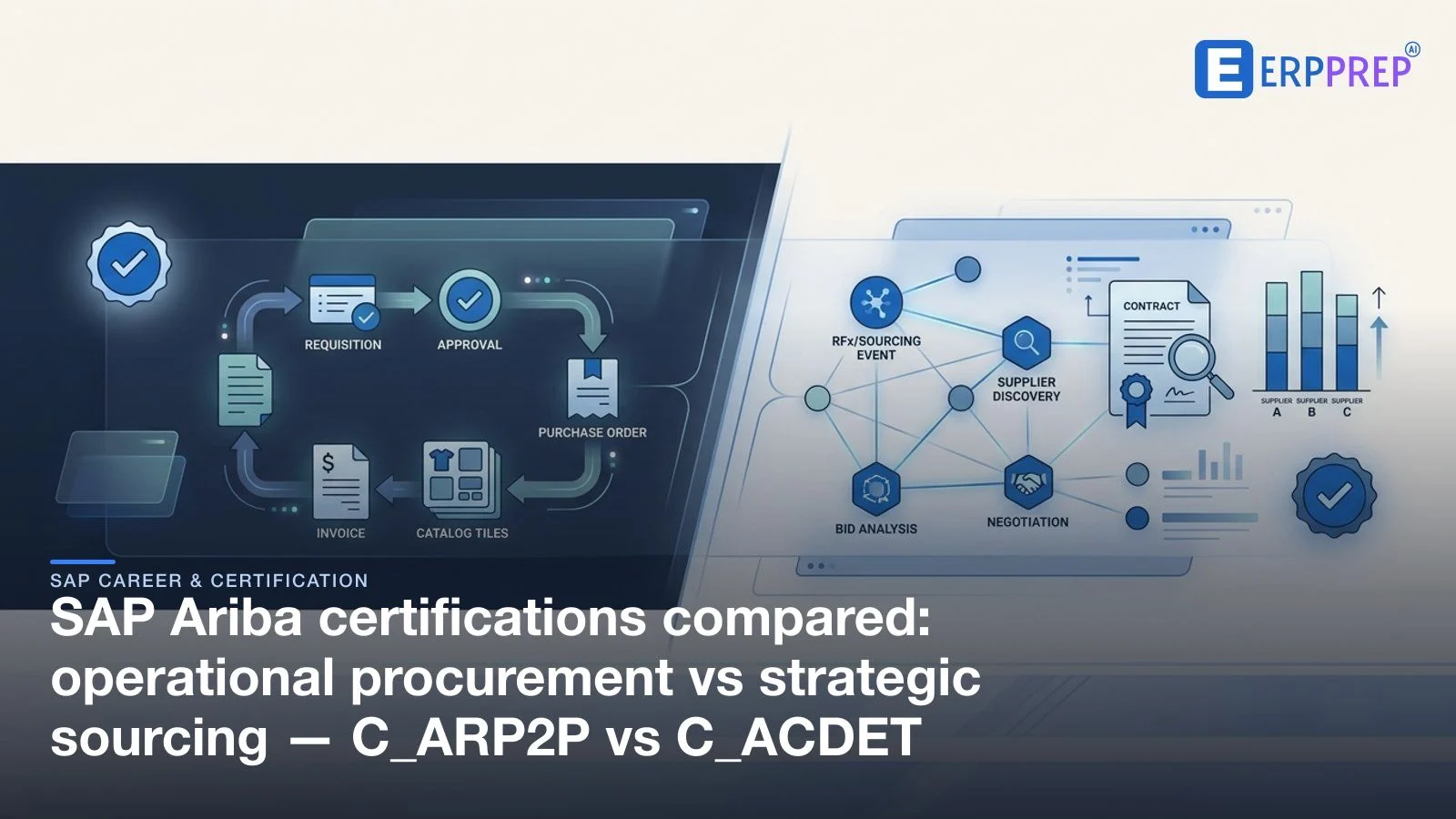
C_ARP2P certifies operational SAP Ariba Procurement — requisitions, catalogs, purchase orders, receiving and invoicing across the procure-to-pay flow. C_ACDET certifies configuring the SAP Ariba Strategic Sourcing Suite — deployment, advanced field configuration, and migration for sourcing events, RFx and contracts. Both are associate Scenario-Based Assessments with a 60% cut score. Choose by the spend work you own: everyday buying, or upstream sourcing setup.
SAP® Ariba covers the whole arc of how organizations find suppliers, agree terms, and then buy against them — and its associate certifications split along that arc. C_ARP2P certifies operational SAP Ariba Procurement: the downstream, transactional side where requisitions become orders and orders become invoices. C_ACDET certifies configuring the SAP Ariba Strategic Sourcing Suite: the upstream side where you set up and tune the platform that runs sourcing events and contracts. This guide compares what each certifies, the shared exam format, and how to choose. For the wider question of which SAP path pays off, see whether SAP certification is worth it and how to choose.
Key takeaways
- C_ARP2P is the operational buying track — it certifies running the procure-to-pay flow: catalogs, requisitions, orders, receiving, and invoicing.
- C_ACDET is the sourcing-configuration track — it certifies deploying, configuring, and migrating the Strategic Sourcing Suite that handles events and contracts.
- Both are associate-level and use the same Scenario-Based Assessment (SBA) format with a 60% cut score, so the pass mark is not the differentiator — the subject matter is.
- They map to different spend-management roles: an operational procurement consultant versus a strategic-sourcing configuration and deployment consultant.
- C_ARP2P is the usual starting point; its source-to-pay grounding makes the upstream sourcing configuration in C_ACDET easier to reason about.
C_ARP2P vs C_ACDET at a glance
Both certifications sit on official SAP Ariba learning journeys (SAP, learning.sap.com) and share a format — but they point at opposite ends of the spend process. Here they are side by side:
| C_ARP2P — Ariba Procurement | C_ACDET — Strategic Sourcing Suite | |
|---|---|---|
| What it covers | Operational procure-to-pay — catalogs, requisitions, purchase orders, receiving, and invoicing | Configuring and deploying the sourcing suite — baseline configuration, advanced field setup, and migration |
| Where it sits in the process | Downstream — buying against agreed sources | Upstream — sourcing events and contracts |
| Best for | Operational procurement / buying consultants | Sourcing configuration and deployment consultants |
| Format | Scenario-Based Assessment (SBA) | Scenario-Based Assessment (SBA) |
| Cut score | 60% | 60% |
What C_ARP2P (SAP Ariba Procurement) covers
The Procurement certification is about running the buying engine. Rather than deciding which supplier wins a category, you make sure that once a source is in place, employees can request goods and services, orders flow to suppliers, deliveries are received, and invoices are settled cleanly. Its earned skills sit in the operational space — procurement management, procurement, and purchasing — and the learning journey frames it as an entry point for consultants getting acquainted with the Ariba product line.
In practice the module spans the procure-to-pay flow end to end:
- Catalogs — loading and managing catalog content, handling formats and validation, working with punch-out catalogs, and controlling how items are searched and displayed so buyers find the right thing.
- Requisitions and guided buying — creating requisitions for materials and services, and configuring the guided-buying experience that steers employees toward compliant purchases.
- Purchase orders — the order lifecycle and statuses, dispatching orders to the business network, amendments, and cancellation or closure of active orders.
- Receiving — recording receipts, differentiating receipt types, handling returns and rejections, and dealing with over- and under-receiving tolerances.
- Invoicing and reconciliation — creating order-based, contract-based, and non-order invoices, working with credit memos, and reconciling invoices against orders and receipts with exception handling.
Two threads run through the whole module and the exam tests them repeatedly. The first is compliance and control: much of operational procurement is about making the compliant path the easy path — the right catalog, the right approval rule, the right contract to buy against — so spend stays inside policy without slowing people down. The second is the match across the three-way relationship of order, receipt, and invoice. Reconciliation is where procurement either runs clean or generates disputes, and a strong candidate can reason about why an invoice fails to reconcile and what the correct resolution is, rather than treating each document in isolation. That judgment — keeping buying compliant and the paperwork matched — is exactly what a Scenario-Based Assessment is built to probe.
What C_ACDET (Strategic Sourcing Suite) covers
Configuring the Strategic Sourcing Suite is a platform and deployment certification. Where Procurement runs the buying process, this credential is about standing up and tailoring the system that supports sourcing — the events, requests-for-x, and contracts that decide who supplies what, on what terms, before any operational order exists. Its earned skills reflect that emphasis: strategic sourcing, system configuration, and procurement, aimed at a consultant or administrator who can work with a strong degree of self-service.
The learning journey is deliberately configuration-heavy and organized around a deployment lifecycle:
- Planning the deployment — understanding the solution architecture, choosing a deployment scenario, applying a configuration baseline, and moving through structured project phases from preparation to go-live.
- Advanced field configuration — working in the customization tooling to adjust standard and custom fields, define field types and conditions, create flexible master data, manage form templates, and handle field translations for multiple languages.
- The object model — understanding the class structure and relationships behind the fields you configure, so changes behave predictably rather than by trial and error.
- Migration to production — planning a production cutover, and executing greenfield, bluefield, or brownfield migrations, including moving configuration packages, master data, form templates, and legacy contracts into the live site.
What makes this credential demanding is that the pieces are sequenced and irreversible in the wrong order. A configuration baseline feeds field customizations; field customizations feed form templates; all of it has to be migrated cleanly into production without breaking what already works. Change one link carelessly and the effect surfaces downstream at go-live, which is the most expensive place to find a mistake. The exam therefore rewards candidates who can reason about the whole deployment chain — what to configure, in what order, and how to move it safely to a production realm — rather than a single setting in isolation. If Procurement rewards knowing the buying process, Strategic Sourcing Suite configuration rewards knowing how to build and migrate the platform underneath it.
The two very different spend-management roles
The clearest way to choose is to look at who actually does each job. They rarely overlap on a project team, even though they share the same product family.
A C_ARP2P specialist is an operational procurement consultant. The work is process-shaped: make sure requisitions, orders, receipts, and invoices flow correctly, that catalogs are current, and that the compliant way to buy is also the convenient one. These roles are more numerous because every organization running Ariba needs day-to-day buying to work, so demand is steady and the on-ramp is broad. If you like keeping a live process healthy and close to the business users who depend on it, this is the role.
A C_ACDET specialist is a sourcing configuration and deployment consultant. The work is build-and-tune shaped: apply a baseline, extend fields, wire up form templates, and migrate the result into production. It sits closer to implementation and platform engineering than to daily operations, and it is narrower and more specialized. That scarcity has its own value — a project cannot deliver a sourcing suite without someone who can configure and migrate it — but the expertise is more tightly bound to the suite and its deployment tooling.
There is a career-shape difference too. Operational procurement skills travel well across procurement organizations and give you a broad base to grow from, including toward the upstream sourcing side later. Sourcing configuration skills are deeper but more concentrated: they make you the person an implementation cannot do without when a sourcing suite is in scope. Neither is "better" — they are simply different bets on how you want your expertise to compound.
Worth noting: this comparison is inside the Ariba world. If your real question is whether to source in the S/4HANA core or in Ariba at all, the S/4HANA sourcing vs Ariba certification comparison answers that adjacent decision.
Not sure how a Scenario-Based Assessment feels? A free sample shows the reason-through-a-scenario style before you commit to a certification. Try a free sample.
Prerequisites and which one to take first
Neither exam is gated behind a formal prerequisite certification. C_ARP2P is explicitly positioned as an entry-level qualification for consultants getting acquainted with the Ariba product line, so it is the natural first step for most people. It also gives you the source-to-pay context — catalogs, requisitions, orders, contracts to buy against, invoicing — that makes the upstream sourcing world easier to picture.
C_ACDET does not demand C_ARP2P on paper, but its content assumes more comfort with the suite because it is configuration- and deployment-heavy from the start: architecture, baseline, field configuration, and migration. Coming to it with operational grounding already in place means you understand what the sourcing configuration eventually feeds, which makes the deployment reasoning land faster. If you are brand new to Ariba, leading with Procurement and then moving to Strategic Sourcing Suite configuration is the smoother sequence. Always confirm any current requirements on each exam page at learning.sap.com before you book.
One practical point on effort. The two learning journeys are not the same size or shape. Procurement spreads across a wide set of everyday functions — catalogs, requisitions, receiving, invoicing, reconciliation — so you hold a broad process in your head. Strategic Sourcing Suite configuration concentrates on fewer areas but with real depth in configuration and migration mechanics. That does not make one exam objectively harder, since the cut score is identical, but it does shape how you budget your study: Procurement asks for breadth across a process, while sourcing configuration asks for depth in a build-and-migrate discipline. Match the plan to the certification you choose.
Format and cut score: both SBA at 60%
This is where the two exams converge. Both C_ARP2P and C_ACDET use the Scenario-Based Assessment (SBA) format — SAP's performance-based style for Ariba, where you work through a connected business scenario and choose the best recommendation or configuration rather than recalling isolated facts. Both also publish the same 60% cut score at the time of writing.
Because the format and pass mark are identical, difficulty is a function of the subject's breadth and your hands-on familiarity, not of the exam mechanics. Procurement asks you to reason across a live buying process; sourcing configuration asks you to reason across a deployment and migration chain. Either way, the winning preparation is the same: practise reasoning through realistic situations. If you want the technique for this exam family, the guide to the performance-based exam format covers how SBAs are built and how to work them under time pressure.
Can you hold both?
Yes — and for some consultants it is a sensible combination. Operational procurement and strategic sourcing meet at contracts and catalogs: a contract negotiated upstream becomes something you buy against downstream, and the same category expertise informs both. A consultant who holds both C_ARP2P and C_ACDET can speak to the full spend-management picture on an Ariba implementation, from setting up sourcing through to keeping the daily buying compliant.
That said, most people do not certify both at once. The stronger play is to lead with the one closest to your current work — usually C_ARP2P — earn real project exposure, and add the second when the role genuinely calls for it. Two credentials with shallow experience behind them are worth less than one credential backed by delivery. Sequence beats simultaneity.
Which one should you choose?
Work backwards from the role you hold or want, not from the exam that looks easier — the cut score is the same, so that is not a real tie-breaker. Three rules of thumb:
- Choose C_ARP2P if your world is everyday buying. You run catalogs, requisitions, orders, and invoicing, or you sit close to accounts payable. Operational procurement is also the broader, more widely staffed skill and the usual first step into Ariba.
- Choose C_ACDET if your world is building the platform. You implement and configure sourcing solutions — deployment, field configuration, and migration. Strategic Sourcing Suite configuration is the deeper, more specialized track.
- Consider both — in sequence — for a full-picture role. On an Ariba implementation the two complement each other, because clean sourcing setup and clean operational buying are two halves of the same spend story. Lead with the module you already touch, then add the second once you have real project exposure.
Still weighing Ariba against the rest of the SAP field? Each exam hub below carries the scenarios, skill drills, and exam facts for that specific certification, and the career pillar places procurement and sourcing among the wider set of SAP options.
Prepare for whichever you pick
Once you have chosen, the approach is the same because the format is shared. Practise doing the work in a realistic setting rather than only reading — trace a requisition through to a reconciled invoice for C_ARP2P, or reason through a baseline, field-configuration, and migration sequence for C_ACDET. Follow whole scenarios end to end, and rehearse under time pressure so your accuracy holds when it counts. Start from the exam hub for your certification, try a free sample to feel the Scenario-Based style, and build from there.
Frequently asked questions
- What is the difference between C_ARP2P and C_ACDET?
- C_ARP2P certifies operational SAP Ariba Procurement — the downstream, transactional side of buying: requisitions, catalogs, purchase orders, receiving, and invoicing across the procure-to-pay flow. C_ACDET certifies configuring the SAP Ariba Strategic Sourcing Suite — the upstream, sourcing side: deploying the suite, performing advanced field configuration, and migrating a configured solution to production for sourcing events and contracts. One runs the buying engine; the other builds and tunes the sourcing platform.
- What exam format does C_ARP2P use?
- C_ARP2P is a Scenario-Based Assessment (SBA), the performance-based style SAP uses for its Ariba associate certifications. You reason through a connected procurement scenario rather than answering isolated multiple-choice trivia. Confirm the current activity count and any updates on the exam page at learning.sap.com.
- What exam format does C_ACDET use?
- C_ACDET is also a Scenario-Based Assessment (SBA). It leans toward configuration and deployment judgment — applying a configuration baseline, extending fields, and planning a migration — framed as a connected scenario rather than recall questions. Check the exam page at learning.sap.com for the latest activity details.
- What is the cut score for C_ARP2P and C_ACDET?
- Both exams publish a 60% cut score at the time of writing. That threshold is the same across the two, so difficulty comes from the breadth and depth of each subject rather than the pass mark. Always confirm the current cut score on each exam's page before you book, because SAP can revise it.
- Which SAP Ariba certification should I take first?
- Most people start with C_ARP2P. Operational procurement is the broader, more widely staffed skill set and gives you the source-to-pay context — catalogs, requisitions, orders, invoicing — that makes the strategic-sourcing side easier to reason about. C_ACDET is a natural second step once you are comfortable in the suite and want to move upstream into sourcing configuration and deployment work.
- Operational procurement or strategic sourcing — which is the better career path?
- Neither is objectively better; they are different bets. Operational procurement (C_ARP2P) roles are more numerous and touch daily buying, so demand is steady and the on-ramp is broad. Strategic sourcing configuration (C_ACDET) is narrower and more specialized — deployment, field configuration, and migration — which can command scarcity value on suite implementation projects. Pick the one that matches the work you want to own.
- Do I need both C_ARP2P and C_ACDET?
- No — each stands on its own and maps to a distinct role. Holding both makes sense for a consultant who wants to cover the full spend-management picture on Ariba implementations, since operational buying and upstream sourcing meet at contracts and catalogs. Most people lead with the one closest to their current work and add the second after real project exposure rather than certifying both at once.
- Are there prerequisites for C_ARP2P or C_ACDET?
- Neither is gated behind a formal prerequisite certification. C_ARP2P is positioned as an entry-level qualification for consultants getting acquainted with the Ariba product line. C_ACDET assumes more comfort with the suite because its content is configuration- and deployment-heavy. In practice, C_ARP2P's procure-to-pay grounding is a helpful foundation before tackling C_ACDET. Confirm any current requirements on each exam page at learning.sap.com.
- Which SAP Ariba certification fits a procurement career best?
- If your career sits in day-to-day buying, catalog management, and accounts-payable-adjacent invoicing, C_ARP2P is the closer fit. If you work on implementing and configuring sourcing solutions — running deployments, tailoring fields, and moving configuration to production — C_ACDET aligns better. Both live in the same spend-management world, so the choice is really about operational execution versus platform configuration.
ERPPrep is an independent platform and is not affiliated with, endorsed by, or sponsored by SAP SE. SAP and other SAP products are trademarks of SAP SE, referenced here only to describe the certification exams ERPPrep helps you prepare for.
Ready to practise the way the exam tests?
ERPPrep provides original, performance-style scenarios and skill drills built for the 2026 SyBA and SBA formats. Try a free sample and judge the quality yourself.
Practice for these exams
Related guides
SAP Intelligent Spend certifications explained: Ariba and Fieldglass, mapped
How SAP's spend certifications fit together — Ariba sourcing, contracts, supplier management, network collaboration, integration, and Fieldglass, mapped by module, format, cut score, and role.
How to prepare for an SAP procurement certification
A practical, format-faithful study guide for the SAP procurement certification family — core S/4HANA sourcing (C_TS452) and the SAP Ariba exams (C_ARP2P, C_ACDET).
SAP Signavio certifications explained
The four certifications around SAP Signavio compared: C_SIGDA, C_SIGPM, C_SIGBT and the rescoped C_SIGVT — what each covers, who it suits, where to start.