

SAP Concur certifications compared: Expense, Invoice, Request and Travel
Four SAP Concur configuration certifications — Expense, Invoice, Request and Travel — compared: what each product's configuration covers, how the four overlap and integrate, which to sit first, and how to prepare for the shared scenario format.
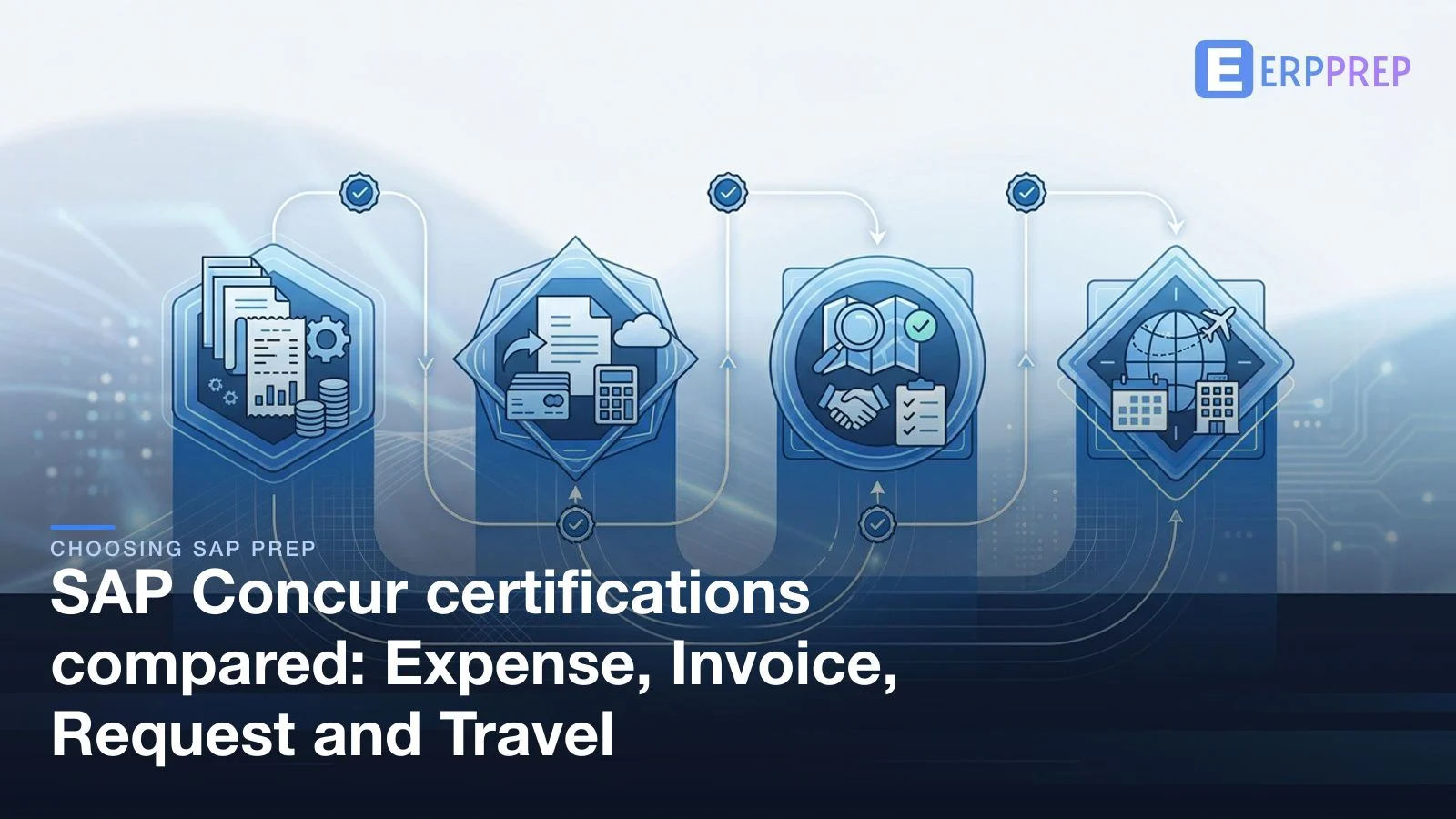
SAP® certifies four Concur configuration credentials, one per product: C_CE325 for Expense, C_CI325 for Invoice, C_CR125 for Request, and C_CT325 for legacy Travel. All four are scenario-based (SBA) exams that publish a 60% cut score, and all four reuse the same configuration grammar — global templates, forms and fields, workflows, policies, groups and audit rules — pointed at a different slice of spend. Expense is the natural foundation, because both Request and Travel list it as a companion product and Request hands its configuration off into it.
The SAP® Concur family is unusual in the certification catalog: instead of one broad credential covering travel and expense, there are four separate configuration certifications, one per product. They share a configuration philosophy, a great deal of tooling, and an identical exam format — which is exactly why candidates pick the wrong one. This guide draws the lines. For the broader question of how to prepare legitimately for any of them, start with choosing how to prepare for SAP certification.
The confusion is understandable. On paper the four look almost interchangeable: each is a “professional edition” configuration exam, each is delivered as a single scenario activity, and each is earned against a learning journey that walks through primary and secondary configuration. The differences that matter are not in the exam mechanics but in which product's spend you are being certified to configure — and in how much of the suite you end up needing. Get the product wrong and you will have studied a real credential that simply does not describe the work in front of you. The sections below pin down what each one actually governs, where they overlap, the order that saves the most effort, and how to prepare for a format that rewards judgement over recall.
SAP® certifies four Concur configuration credentials, one per product: C_CE325 for Expense, C_CI325 for Invoice, C_CR125 for Request, and C_CT325 for legacy Travel. All four are scenario-based (SBA) exams with a 60% cut score. Expense is the natural foundation, because Request and Travel both integrate with it.
Key takeaways
- One credential per product, not per role. C_CE325, C_CI325, C_CR125 and C_CT325 each certify configuring a single Concur product.
- Identical format and bar. All four are Scenario-Based Assessments (SBA) built on one activity, each published with a 60% cut score (learning.sap.com).
- Expense is the anchor. Request integrates into it and the Travel journey lists it as a companion product, so the expense configuration model pays off three times.
- Effort is not equal. The Request path is the leanest; the legacy Travel path is by far the heaviest, with nine recommended courses.
- One is an administrator credential. C_CR125 is titled for a Configuration Administrator; the other three are Configuration Consultant certifications.
What are the four SAP Concur certifications, and how do they differ?
Each exam is published on SAP's learning site (SAP, learning.sap.com) with its own learning journey. Here is the side-by-side, each linking down to its exam hub:
| Spend it governs | Credential title | Journey weight | |
|---|---|---|---|
| C_CE325 — Expense | Employee out-of-pocket and card spend, after the fact. | Configuration Consultant | Three recommended courses. |
| C_CI325 — Invoice | Supplier spend: purchase requests, orders, and payables. | Configuration Consultant | Two recommended courses. |
| C_CR125 — Request | Spend approved before it happens. | Configuration Administrator | Two recommended courses — the leanest path. |
| C_CT325 — legacy Travel | Booking: air, hotel, car, rail, and travel policy. | Configuration Consultant | Nine recommended courses — the heaviest. |
Never sat a scenario-based SAP exam? The SBA style rewards judgement over recall, and it feels different from a classic quiz. Try a free sample to see the format before you commit to a product.
The four Concur certifications at a glance
Before the product-by-product detail, here is the same four laid out against the decisions candidates actually weigh — the exam mechanics, the slice of spend each governs, and the profile it fits best. Every one is scenario-based with the same pass bar, so the deciding column is almost always the last one.
| Exam | Format & bar | Scope in one line | Best for |
|---|---|---|---|
| C_CE325 — Expense | SBA, single activity, 60% cut score. | Reimbursing employee spend after it happens. | The foundation credential for anyone new to the suite. |
| C_CI325 — Invoice | SBA, single activity, 60% cut score. | Paying suppliers: requests, orders, matching, payables. | Consultants on accounts-payable and procurement projects. |
| C_CR125 — Request | SBA, single activity, 60% cut score. | Approving spend before it is committed. | Administrators maintaining a pre-approval site. |
| C_CT325 — legacy Travel | SBA, single activity, 60% cut score. | Booking behaviour and travel policy end to end. | Specialists implementing the legacy Travel product. |
Read the table as a filter rather than a ranking. None of the four is “harder” in the sense of a stricter pass bar — the 60% cut score is uniform — but they differ sharply in breadth of surface area and in how much of it you will use day to day. The right choice is the row whose “best for” description matches the projects you are actually staffed on, and the sections that follow explain why.
What does the Concur Expense certification cover?
C_CE325 is the deepest single-product configuration exam in the family, and its journey splits cleanly in two. The primary layer is the structural skeleton of a site: the global template, list management, forms and fields with their connected lists and conditional behaviour, payment types, expense types and their account codes, general ledgers and accounting hierarchies, workflows and approver maintenance, feature hierarchies, policies, and group configuration.
The secondary layer is everything that makes a live site workable: the processor queue where reports are actually reviewed, company administration for users and permissions, custom and random audit rules, personal and company car mileage rates, delegates, email reminders, attendee types, receipt handling and imaging, locations, printed reports, tax authorities, reporting preferences, and travel allowance rate bundles. A third, short course introduces Joule, SAP's assistant, across the Concur products. If you want one credential that teaches you how a Concur site is assembled, this is it.
The reason Expense earns its place as the anchor is not that it is the hardest exam but that it is the most generative: nearly every configuration object you meet here — the connected-list behaviour behind a form field, the way a workflow routes to an authorised approver, the difference between a group configuration and a policy, how an audit rule fires an exception message — reappears in Invoice and Request under a different label. Learn it once and you are reading the other journeys as variations on a theme rather than starting cold. The learning journey is pitched at an intermediate level and runs to roughly fifteen hours of guided course time across its two configuration courses plus the short Joule introduction, and it explicitly frames the primary and secondary components in terms of how their relationships shape system behaviour, compliance and usability — which is precisely the reasoning a scenario exam probes.
What does the Concur Invoice certification add?
C_CI325 reuses the same configuration grammar — global template, lists, forms and fields, workflows, policies, groups, feature hierarchy — but points it at supplier spend instead of employee spend. The distinctive content is the accounts-payable machinery: maintaining vendors and vendor access mapping, purchase request and purchase order approvers with their own reason codes, PO number sequences, purchase order matching rules, the AP dashboard with capture batches and reimbursements, and the processor queries that route work to the right team.
That overlap is genuinely useful. A consultant who already holds the expense credential will recognise most of the primary configuration tools immediately and can concentrate on what is new: the vendor master, matching, and the capture-processing settings. The reverse is also true, but less efficient — invoice-first candidates still meet the shared model, just in a narrower context.
What genuinely sets Invoice apart is the accounts-payable dashboard and the matching engine. The secondary course spends real time on capture processing — the admin settings, task definitions, supplier email handling and the capture batches that turn scanned invoices into records the system can route — and on purchase-order matching rules that decide when an invoice can be paid against its order without human intervention. None of that exists in the Expense world, because employees, not suppliers, originate the spend. There are smaller product-specific touches too: ship-to and bill-to company locations, units of measure and shipping configuration for purchase requests, and routing-hierarchy mappings that steer approvals. If your customers care about payables throughput and three-way matching, this is the credential that certifies you can build it; it sits at roughly fourteen hours of course time across two intermediate courses.
Why is Concur Request an administrator credential?
C_CR125 sits earlier in the spend lifecycle: it governs the approval that happens before money is committed. Its learning path is the shortest of the four and is deliberately two-sided. The first course is beginner-level and business-user facing — building a request with the assistant or as a quick request, attaching travel segments, expected expenses, travel allowances and allocations, submitting for approval, then reviewing and approving as an approver, plus the processor tools for searching and querying.
The second course is where the certification earns its name. It covers the request configuration tools, forms for the header, entry and allocation levels, segment types, request policies and groups, delegates, site settings, audit rules, travel agency offices, and printed reports — and it ends with a dedicated unit on integrating requests with the expense product. That integration unit is the strongest argument for taking C_CE325 first: the request configuration is designed to hand off into an expense configuration you are expected to understand.
That two-sided shape — a business-user course followed by a configuration course — is why C_CR125 makes such a forgiving entry point despite integrating with the most complex product in the family. You spend the first stretch simply using the product the way an approver or requester would, which builds an intuition for what the configuration is for before you touch a single setting. The journey is the shortest of the four at roughly twelve hours of course time, and it is listed against Concur Request and Concur Expense together precisely because the two are meant to run as a pair. The catch is the one already noted: the final integration unit assumes you can read an expense configuration, so a candidate who takes Request in isolation will meet forms, policies, site settings, audit rules and workflows on the expense side that were never explained. Sequencing Expense first removes that gap entirely.
What makes the Travel certification the biggest of the four?
C_CT325 certifies the legacy Concur Travel product, and its journey is roughly twice the length of the others across nine recommended courses. The breadth is real. Company administration alone spans approval queues, company locations and org units with their import templates, report administration, custom user and trip fields with conditional logic, company settings, single sign-on and sign-in behaviour, and legal entities. User administration adds profiles, permissions, sponsored non-employee users, and company groups.
Then come the travel-specific layers most consultants underestimate: corporate and virtual ghost cards, BIN restrictions on credit cards, unused-ticket handling, data-retention activation, rule classes and the travel rule builder, policy-violation reasons, vendor exclusions, regional hotel rates, corporate discounts across air, hotel, car and rail, non-GDS hotel management, the company tree and agency booking configuration, and a long travel configuration page covering connectors, search and sorting behaviour, email options, form of payment, and agency handling. A final course walks an implementation from requirements through testing to go-live. Budget accordingly.
Travel is also the one place where the shared configuration spine mostly does not help you. Where Expense, Invoice and Request all revolve around the same global template, forms, workflows and groups, the legacy Travel administration model is largely its own world — company and user administration, the company tree, agency booking and the travel configuration page have no direct analogue in the other three. The connective tissue is thin: the same Joule introduction appears, and the journey lists Concur Expense as a companion product because travel bookings ultimately feed expense reporting. Practically, that means the prior-credential discount you get moving from Expense to Invoice does not carry into Travel to the same degree, which is a second reason — on top of its sheer size — to sit it only when the product is genuinely in your project scope. At more than twenty hours of course time across nine courses, it is a specialist commitment, not a completionist's trophy.
How do the four Concur certifications overlap and integrate?
The single most useful mental model for this family is a shared configuration spine with four different heads. Expense, Invoice and Request are all built on the same recurring objects: a global template and configuration relationship diagram, list management, forms and fields with connected lists, feature hierarchy, workflows and approvers, policies, group configuration, audit rules, delegates, email reminders and printed reports. Each certification takes that spine and specialises it — Expense for reimbursable employee spend, Invoice for supplier payables, Request for pre-approval — so a large share of what you learn for one is directly transferable to the next. That is the overlap, and it is the reason the second and third credentials feel materially lighter than the first.
Integration is a separate idea from overlap, and Request is where it is most explicit. Its configuration course ends with a dedicated unit on wiring requests into Concur Expense: the request a traveller submits before a trip becomes the expense report they file afterward, so the two products' policies, forms, audit rules and workflows have to line up. Travel sits upstream of the same flow — a booking becomes a trip, which becomes spend to reconcile — which is why its journey, too, names Concur Expense as a companion. In a fully deployed customer, Request approves the intent, Travel books it, and Expense settles it, with Invoice handling the supplier side in parallel. Understanding those handoffs is exactly the kind of cross-product reasoning a scenario question likes to test.
The flip side of overlap is interference. Because group configuration, forms and fields, and audit rules behave similarly but not identically across the products, a candidate who half-remembers the Expense version of a setting can confidently pick the wrong option on an Invoice or Request scenario. The shared vocabulary that accelerates your second credential becomes a trap if you blur the products together, which is the practical case for finishing one cleanly before starting the next rather than cramming two at once.
Do all four use the same exam format?
They do, and that is unusually convenient. Per learning.sap.com, every one of the four is a Scenario-Based Assessment (SBA) built around a single activity, and each publishes a 60% cut score. So the exam technique you build for one transfers wholesale to the others: read a customer situation, hold its constraints in mind, and choose the configuration response that satisfies them rather than the one that merely works.
The practical consequence is that memorising screens will not carry you. SBA preparation rewards rehearsing decisions — why a group configuration rather than a policy, why an audit rule rather than a required field, why a workflow step rather than a delegate. That is the same muscle across all four Concur exams, and it is worth building deliberately; the performance-based exam format guide covers the underlying technique.
Uniform format also has a planning benefit worth naming: it lets you amortise your exam-technique investment across up to four credentials. Once you have learned to slow down on a scenario, list its constraints, and eliminate options that are technically valid but violate a stated requirement, that discipline applies unchanged whether the activity is about an expense group, a purchase-order matching rule, a request policy or a travel rule class. The content differs; the reasoning pattern does not. That is a strong argument for treating your first Concur exam as much a lesson in how these assessments think as in the product itself, because the technique compounds across the rest of the family.
In what order should you take them?
Sequence by dependency, not by interest. Three rules settle most cases:
- Expense first, in almost every case. It teaches the configuration model the whole suite reuses, and both Request and Travel list the expense product alongside their own.
- Then follow your customers' spend. If your projects are supplier-heavy, add C_CI325. If they are travel-heavy with pre-approval, add C_CR125.
- Take Travel when the product is actually in scope. C_CT325 is the largest investment of the four and is scoped to the legacy Travel product — worth it when you support it, wasteful when you do not.
Do not study two in parallel. The shared vocabulary that makes the second credential faster after the first becomes a source of confusion when you learn both at once — group configuration, forms and fields, and audit rules behave similarly but not identically across products, and blurring them is the classic way to fail a scenario question.
How should you prepare for a Concur configuration exam?
Because all four are scenario-based, effective preparation looks different from cramming a fact sheet. Work in three layers. First, cover the ground: read through the official learning journey for your chosen product so you have met every configuration object at least once — the primary components first (global template, forms and fields, workflows, policies, groups) and then the secondary and administrative tools (audit rules, delegates, receipt or capture handling, reporting settings). Missing an object entirely is what turns an answerable scenario into a guess. Second, get your hands on a practice system if you possibly can: these are configuration credentials, and clicking through a form, a connected list or an audit rule fixes the relationships in a way that reading never does.
The third and most decisive layer is rehearsing the reasoning. Give yourself realistic customer situations with competing constraints and practise choosing the configuration that satisfies all of them — why a group configuration rather than a policy, why an audit rule rather than a required field, why a workflow step rather than a delegate — then articulate the trade-off out loud. That habit is what the scenario format actually scores. Time the exercise, too: working under a mild clock trains you to read the constraints once, carefully, rather than second-guessing. This is where original, scenario-shaped practice earns its keep — not by handing you answers to memorise, but by putting you through the decisions the assessment will ask you to defend. Never lean on exam dumps or leaked questions; they are against SAP's rules, they can cost you the credential, and against a reasoning exam they teach nothing you can reuse on the next of the four.
Which SAP Concur certification should you choose?
Work backwards from the spend you are asked to control. If your stakeholders argue about receipts, mileage, and expense-report approvals, that is C_CE325. If they argue about supplier invoices, matching, and payables throughput, that is C_CI325. If they want spend approved before it is committed, that is C_CR125. If they are configuring booking behaviour, agency handling, and travel policy, that is C_CT325.
Whichever you choose, prepare by reasoning rather than memorising, and be honest about the format: these are scenario exams, so rehearse defending configuration decisions under a customer's constraints. ERPPrep does not publish exam dumps or copies of live questions — that route risks your credential and teaches nothing transferable. For how the wider certification catalog is structured around this kind of product-family choice, see the sourcing versus Ariba comparison, which makes the same core-versus-cloud distinction on the procurement side.
If you are still weighing which product to commit to, the fastest way to make the decision concrete is to feel the format for yourself. The reasoning demanded by a Concur scenario is the same whichever exam you eventually sit, so a single worked example tells you more about whether you are ready than any amount of reading about the syllabus. Try a free sample scenario and see how the judgement-first style feels before you pick your first Concur credential.
Frequently asked questions
- How many SAP Concur certifications are there?
- There are four product-aligned configuration certifications in this family: C_CE325 for Concur Expense, C_CI325 for Concur Invoice, C_CR125 for Concur Request, and C_CT325 for the legacy Concur Travel product. Each targets one product's configuration and administration surface, and each is certified independently — there is no single combined Concur credential that spans all of them. That structure is deliberate: a consultant staffed on an expense rollout is rarely doing supplier-invoice matching or travel-booking policy in the same breath, so SAP certifies each product where it is actually implemented rather than bundling four jobs into one exam.
- Which SAP Concur certification should I take first?
- Start with C_CE325 for Concur Expense unless your project says otherwise. Expense is the hub the rest of the suite attaches to: the Request learning path devotes an entire course to wiring requests into the expense product, and both the Request and Travel journeys list Concur Expense among their products. The primary configuration objects — the global template, forms and fields, workflows, policies, groups and audit rules — are introduced most fully in the Expense material, and the same objects reappear, product-flavoured, in the other three. Learning that model once makes each later credential faster to earn and harder to confuse.
- What is the difference between Concur Expense and Concur Invoice certification?
- C_CE325 certifies employee-initiated spend: expense reports, receipts, mileage, cash advances, attendees, and the policies and workflows that govern reimbursement after the money is spent. C_CI325 certifies supplier-initiated spend: vendor records and access mapping, purchase requests, purchase orders with their matching rules, the accounts-payable dashboard, invoice capture, and payment handling. The configuration tooling rhymes across both — the same global template, list management, forms, workflows and groups — but the business process, the master data, and the people who use it are different. Invoice adds a genuinely new layer in purchase-order matching and capture processing that Expense never touches.
- Are all SAP Concur exams the same format?
- Yes. According to learning.sap.com, all four use SAP's Scenario-Based Assessment (SBA) format built around a single connected activity, and all four publish a 60% cut score. Practically, that means the exam technique you build for one transfers wholesale to the others: you read a customer situation, hold its constraints in mind, and choose the configuration response that satisfies them rather than the one that merely functions. Preparation should therefore centre on reasoning through a realistic implementation, not on memorising menu paths or field names, because the assessment is testing judgement about why one setting fits the requirement over another.
- Why is Concur Request a Configuration Administrator certification?
- C_CR125 is titled as a Configuration Administrator credential rather than a Configuration Consultant one, and its learning path reflects that emphasis. It opens with a beginner-level, business-user course on creating, submitting, reviewing and approving requests — attaching travel segments, expected expenses, allocations and travel allowances — before its second course moves into the configuration and integration tooling. That shape leans toward running and maintaining an existing Request site as much as building one from scratch, which is why the administrator title fits. It also makes Request the gentlest on-ramp of the four for someone newer to the Concur platform.
- How long does it take to prepare for an SAP Concur certification?
- SAP publishes an estimated duration for each learning journey, and they differ substantially. The Request path is the leanest at roughly twelve hours of course time across two courses; Invoice sits near fourteen hours, also across two; Expense is close to fifteen hours across three; and legacy Travel is by far the heaviest at more than twenty hours spread over nine recommended courses. Treat those figures as guided-course time only — hands-on configuration in a practice system, plus scenario rehearsal, sits on top. A realistic calendar for most candidates is several weeks per credential rather than a weekend.
- Does ERPPrep provide real SAP Concur exam questions or dumps?
- No. ERPPrep does not provide exam dumps or copies of live questions, and relying on them risks your certification and breaches SAP's rules — SAP can revoke a credential obtained that way, and dumps teach nothing you can defend in a scenario. What ERPPrep publishes instead is original, scenario-shaped practice written against the published skill areas for each Concur exam, so you rehearse the configuration reasoning the assessment actually asks for. Because the exams are scenario-based, memorised answer keys would not help even if they were legitimate; the format rewards understanding, not recall.
- Is the legacy Concur Travel certification still worth taking?
- It depends on what your customers run. The exam is explicitly labelled for the legacy Travel product, so it certifies a defined, established configuration surface rather than a newer one. If you support or implement that product today — building travel policy, agency booking, corporate discounts and the travel configuration page — the credential maps directly to billable work and is worth the heavier study load. If your accounts are not on legacy Travel, the same weeks are better spent on Expense, Invoice or Request, where the configuration you learn will be used. Let your project pipeline, not curiosity, decide.
- Do the SAP Concur certifications share the same underlying configuration model?
- Largely, yes, and that is the single most useful fact for planning your studies. Expense, Invoice and Request all build on a shared spine — a global template, list management, forms and fields with connected lists, workflows and approvers, feature hierarchy, policies, groups and audit rules — and configure that spine for their own slice of spend. Travel is the outlier: its administration model is travel-specific, though it still shares the Joule introduction and lists Concur Expense as a companion product. Recognising the shared objects is what lets the second and third credentials go faster than the first.
- What roles and skills do the SAP Concur configuration certifications target?
- Across the four exams, learning.sap.com points the journeys at consultant, support consultant, administrator and data-analyst roles — the people who stand up, integrate and maintain a Concur site for a customer rather than the everyday traveller submitting a report. The skill areas emphasise implementation, product lifecycle management and product support, with system administration featuring in Request and system configuration, business-process management and travel planning surfacing in Travel. In short, these are implementation and administration credentials: they assume you are configuring the product for an organisation, which is exactly why scenario-style, constraint-driven practice matches them so well.
ERPPrep is an independent platform and is not affiliated with, endorsed by, or sponsored by SAP SE. SAP and other SAP products are trademarks of SAP SE, referenced here only to describe the certification exams ERPPrep helps you prepare for.
Ready to practise the way the exam tests?
ERPPrep provides original, performance-style scenarios and skill drills built for the 2026 SyBA and SBA formats. Try a free sample and judge the quality yourself.
Practice for these exams
Related guides
How to choose between two SAP certifications
Torn between two SAP certifications? A six-criteria framework — goal, demand, background, format, prerequisites, stacking — breaks the tie for good.
SAP BTP certifications explained: which one is right for you
A map of the SAP BTP certification family — administrator, architect, integration, ABAP and generative-AI developer, LeanIX EA — and how to choose.
SAP SuccessFactors Compensation vs Variable Pay certification: C_THR86 vs C_THR87
Two SAP SuccessFactors reward-management associate certifications. C_THR86 (Compensation — base pay, merit and salary planning) vs C_THR87 (Variable Pay — bonus and incentive programs): what each covers, the shared format and cut score, and which to sit first.