

SAP certification ROI: is the return worth the cost?
SAP certification has a cost — exam fee plus preparation — and a potential return in pay, mobility, and credibility. Here's an honest way to think about the ROI, why it varies, and how to tilt it in your favour.
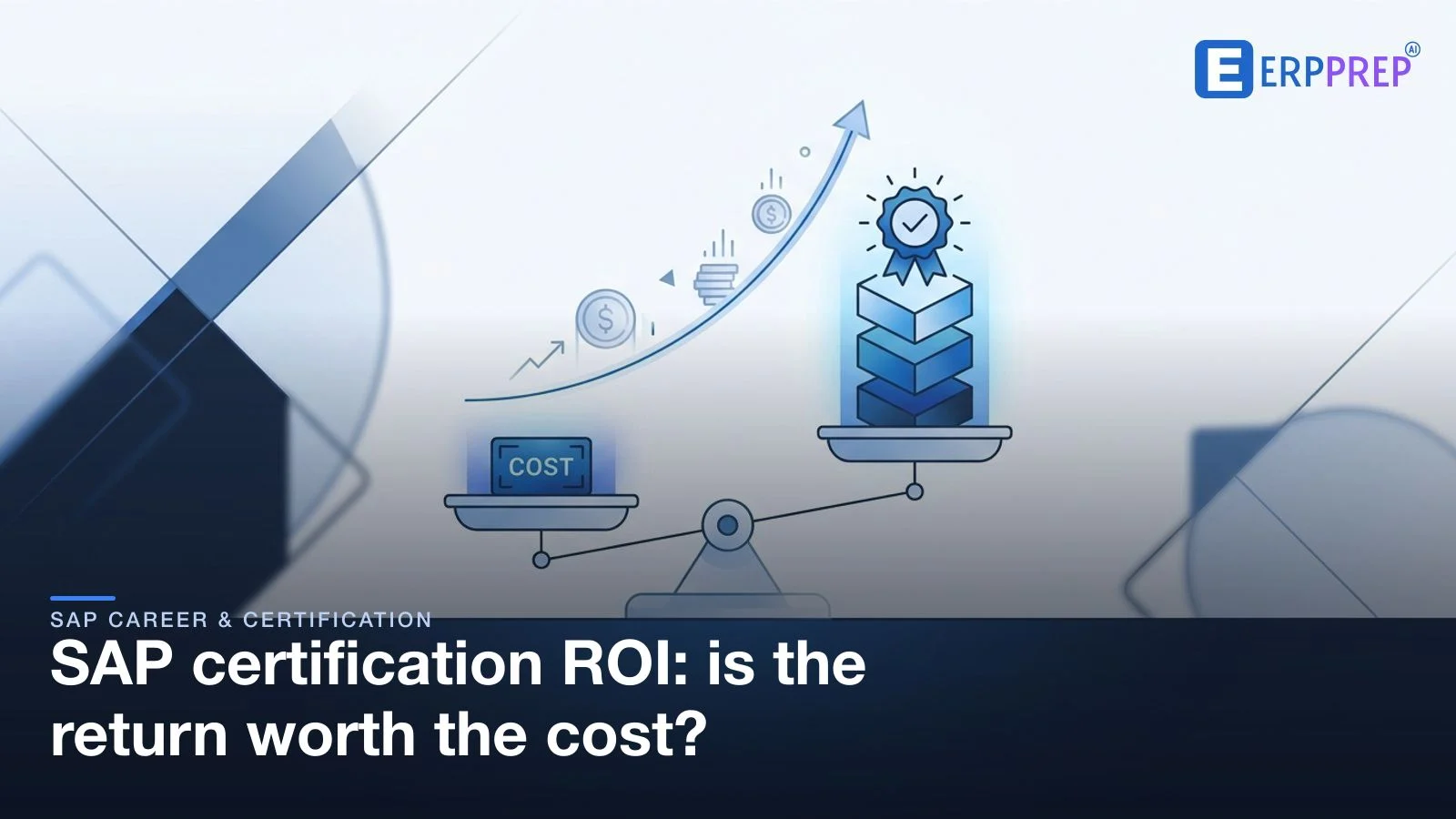
SAP certification ROI compares its cost (exam fee plus preparation) against the return: better pay potential, career mobility, and credibility with employers. The return isn't guaranteed and varies with your experience, region, and how in-demand your area is — a certification is a signal that pays off most when paired with real capability. You improve the ROI by choosing a current, in-demand area, preparing cost-effectively, and passing on the first attempt.
Any investment question comes down to cost versus return, and SAP® certification is no different: you pay an exam fee and put in preparation, in exchange for a potential lift in pay, mobility, and credibility. The honest answer to "is it worth it?" is "it depends — and here's on what." This guide gives you a clear, number-honest way to think about the ROI: what it actually means for a credential, the two sides of the equation, when the return is strongest and when it's weak, and the levers you control to tilt it in your favour. For the broader worth-it question, see whether SAP certification is worth it.
Key takeaways
- ROI is a ratio, not a promise — it weighs cost (exam fee plus preparation) against a return (pay potential, mobility, credibility) that is never a fixed number.
- The return is largest when the certification is current, in-demand, and paired with real experience — a signal that validates delivery, not a substitute for it.
- The cost side is where you have the most control: the exam fee is set, but preparation is a choice, so preparing cost-effectively is the main lever.
- ROI is weakest in crowded or legacy-only areas, when the certificate stands alone, or when a first-attempt fail doubles the outlay.
- You maximise the return by choosing a durable area, backing it with experience, and passing first time — the levers, not the luck.
The ROI factors at a glance
Before the detail, here is the whole picture on one screen: each thing that moves the return, what it actually adds, and the practical way to get more of it. The rest of the guide expands each row.
| ROI factor | What it adds | How to maximise it |
|---|---|---|
| Pay uplift potential | A recognised signal that can support higher rates or salary bands when it validates skills the market is short of. | Certify in a current, in-demand area and pair it with delivery you can point to; see the attributed salary guide for the return side. |
| Faster hiring & mobility | A portable, verifiable filter that helps you clear shortlists and move between employers or roles. | Choose a credential recruiters actually screen for — see whether certification helps you get hired. |
| Credibility | Third-party validation of capability you couldn't otherwise prove on paper, especially when changing employers. | Keep it current and back it with real configuration experience so the claim holds up in interviews and on projects. |
| Skills you keep | The preparation itself — genuine, transferable capability that outlasts the certificate and compounds on the job. | Prepare by doing, not only reading, so the skill is real; the performance-based prep approach builds it. |
| Cost side | The outlay you're measuring the return against — a fixed exam fee plus a preparation spend you choose. | Prepare cost-effectively and pass first time; a free sample helps you target the spend. |
What ROI means for a certification
Return on investment is a ratio: what you get back divided by what you put in. For a physical asset both sides are measurable, which is why ROI feels precise. A certification is different — the "investment" is real money and time, but the "return" is a signal, and a signal only converts to value when the market reads it and acts on it. That is the honest frame: a certification doesn't pay you directly; it raises the probability of outcomes — a role, a rate, a shortlist place — that you then have to convert. So the useful question isn't "what does certification pay?" but "in my situation, how much does this signal move the odds, and is that worth the outlay?" That reframing is why a blanket "certification pays X" claim is misleading, and why the same credential can be a strong investment for one person and a mediocre one for another.
The two sides of the equation
On the cost side: the exam fee (set by SAP, varies by region — confirm officially) plus your preparation, which is largely a choice about how much to spend and where. On the return side: the pay uplift potential, access to new roles, and credibility with employers that a recognised credential can bring. Neither side is a fixed number — which is exactly why a blanket "certification pays X" claim is misleading. For attributed pay figures to inform the return side, our SAP consultant salary guide cites public sources with their caveats; here we focus on the logic.
One nuance worth internalising: the two sides move on different clocks. The cost is front-loaded and certain — you pay the fee and spend the prep time up front, whether or not the return ever arrives. The return is back-loaded and probabilistic — it shows up later, unevenly, and only if the signal lands in a market that values it. A rational way to read that asymmetry is to keep the certain cost as low as is sensible without hurting your odds of passing, and to concentrate your effort on the factors that actually raise the probability of a return.
The cost side, honestly
The cost side has two parts that behave very differently. The exam fee is fixed: SAP sets it for a given exam and region, you don't negotiate it, and it's the same whether you're brilliantly prepared or under-prepared. The preparation cost is the flexible part, and it's where most of the real spend lives — training, materials, practice, and the time you take away from other things. Because prep is the lever you control, it's also where ROI is most often won or lost.
Two failure modes hurt the ratio from opposite directions. Overspending — buying more training than your situation needs, or duplicating resources — inflates the cost without raising your odds of passing. Under-spending — skimping to the point that you fail — is worse, because a retake means paying the exam fee again and repeating the prep, so a false economy on the cost side quietly doubles it. The cost-effective path is the middle one: enough authoritative, format-faithful preparation to pass confidently on the first attempt, and no more. For the full breakdown of what the outlay consists of, see how much SAP certification costs and the most cost-effective way to get certified.
The return side: pay, hiring, and credibility
The return isn't one thing — it's three overlapping benefits, and which one matters most depends on where you are in your career.
- Pay potential. A recognised credential can support a higher rate or salary band, but only when it validates skills the market is short of — it doesn't create value on its own, it evidences value you can deliver. For attributed figures with their caveats, our SAP consultant salary guide cites public sources; the highest-paying certifications guide shows where the strongest bands cluster.
- Faster hiring and mobility. A certification is a portable, verifiable filter — it helps you clear automated screens and shortlists, and it travels with you between employers. That mobility is a return in itself: the option to move is worth something even before you exercise it. See whether certification helps you get hired for how recruiters actually use it.
- Credibility. The credential is third-party validation of capability you often can't otherwise prove on paper — especially valuable when you're changing employers, where your reputation doesn't travel but a recognised certification does.
Notice that none of these are guaranteed and all of them scale with your market. The certification raises your probability of the outcome; your experience and the demand for your area set how large the outcome is.
What makes the return large — or small
The same certification can be a great investment for one person and a mediocre one for another. Three factors decide which:
- Demand and scarcity. A credential in a current, in-demand area returns more than one in a crowded or legacy-only space — the market pays for skills that are hard to find. See the highest-paying SAP certifications for the pattern.
- Experience pairing. A certification signals capability; experience proves delivery. Together they command far more than either alone, so the return is highest when the credential validates real skill.
- Currency. Skills current on S/4HANA hold their value as the market migrates, protecting the return over time — a dynamic explored in the ECC-to-S/4HANA migration careers guide.
When ROI is strongest
Put the factors together and a clear profile emerges of the situation where SAP certification returns the most. The ROI is strongest when you are already working in — or moving into — a current, in-demand area, so the signal validates skills the market is actively short of; when you can back the credential with real delivery, so it evidences capability rather than substituting for it; when the area is built on current products like S/4HANA that hold their value as the market migrates; and when you prepare efficiently and pass first time, keeping the cost side lean. In that profile the certification converts something you can already do into a recognised, portable signal — which is close to the ideal return, because you're paying mainly for validation of value you already hold.
This is why experienced candidates often see the cleanest ROI: the learning curve is short, so the cost side is low, while the validation unlocks roles, rates, and moves that were previously hard to evidence. If that's you, the question isn't really whether to certify but which certification to get first.
Lower the cost side before you commit: a free sample lets you gauge your readiness and the format at no cost, so your prep spend is well targeted and you protect the ratio from the start. Try a free sample.
When ROI is weak
The mirror image is just as instructive. The return thins out — sometimes to the point of not being worth the outlay — in a few recognisable situations:
- Crowded or legacy-only areas. If many candidates already hold the same credential, or it's tied to a product the market is migrating away from, the scarcity that drives the return simply isn't there.
- The certificate standing alone. Treating certification as a substitute for experience rather than a validation of it is the most common way to get a weak return — the signal makes a promise your delivery can't keep, and the market discounts it quickly.
- A first-attempt fail. Because a retake adds another exam fee and more preparation without changing the return, an avoidable fail is one of the fastest ways to halve your ROI.
- Speculative certifying. Certifying in an area you have no path to gaining experience in front-loads all the cost against a return that may never arrive, because you can't convert the signal without the delivery behind it.
None of these mean certification is a bad idea — they mean the choice of area and honest readiness matter more than the credential itself. Avoid these traps and the weak-ROI scenarios largely disappear.
How to maximise your return
You can't control the market, but you can control the ratio, and the levers are the same ones the sections above keep pointing to. Pull them deliberately:
- Choose well. Pick a current, in-demand area aligned with work you can actually get experience in. This single decision moves the return more than anything else, because it sets both the scarcity and the experience-pairing you'll be able to build.
- Prepare cost-effectively. Use authoritative content and affordable, format-faithful practice; skip wasteful shortcuts and redundant resources. The goal is enough preparation to pass confidently on the first attempt — not the most preparation money can buy.
- Pass first time. Gauge your readiness honestly before you book, and rehearse in the real exam format so there are no surprises. A first-attempt pass keeps the cost side lean without touching the return.
- Back it with delivery. Keep building hands-on experience in the module so the credential validates real capability. The signal and the delivery together are worth far more than either alone.
The through-line is that ROI is mostly a series of good choices, not luck. Choosing a durable area lifts the return; preparing cost-effectively and passing first time protect the cost; pairing the credential with experience makes the whole signal credible. Do all four and the ratio tends to take care of itself.
The pragmatic verdict
For most people in a current, in-demand area who prepare properly and pass first time, SAP certification tends to return more than it costs — not because the certificate is magic, but because it converts capability into a recognised, portable signal that opens doors and supports rates. On a core track like SAP S/4HANA Finance (C_TS4FI), the ROI logic is the same: pick a durable area, prepare cost-effectively, back it with experience, and the return takes care of itself. Treat it as an investment in provable capability, and it usually pays.
From here, sharpen the two decisions that move the ratio most. To place your area against the full landscape, use the complete map of SAP certification tracks; to keep the cost side lean, see the most cost-effective way to get certified and how to prepare. And for the question underneath all of this, the pillar on whether SAP certification is worth it ties the ROI logic to the bigger career picture.
Frequently asked questions
- Does SAP certification have a good return on investment?
- It can, but it isn't automatic. The return comes from the capability the credential signals — better pay potential, mobility, and credibility — and it's largest when the certification is current, in an in-demand area, and backed by real experience. As a signal paired with delivery it tends to pay for itself; as a certificate alone, less so.
- How do I calculate the ROI of an SAP certification?
- Weigh the cost (exam fee plus preparation) against the realistic return (pay uplift potential, new roles, credibility) over time. Both sides vary — the exam fee is set by SAP and prep cost is a choice, while the return depends on your market and experience. For attributed pay data to inform the return side, see our SAP consultant salary guide.
- What lowers the ROI of certification?
- Certifying in a crowded or legacy-only area, treating the certificate as a substitute for experience, and overspending on preparation (or under-spending and failing). Each weakens either the cost or the return side. A current, in-demand certification prepared for cost-effectively is the opposite — it maximises the ratio.
- Is certification worth it if I already have experience?
- Often yes, because it converts experience you can't easily prove into a recognised, portable signal — useful for new roles, rates, or moving employers. The ROI here is less about learning and more about validation, which is why experienced candidates can prepare efficiently and still get a strong return.
- When is the ROI of an SAP certification weakest?
- When the area is crowded or tied to a legacy product the market is migrating away from, when the certificate stands alone with no hands-on delivery behind it, and when a first-attempt fail doubles the cost. In those cases the return can be thin relative to the outlay, so the choice of area and honest readiness matter more than the credential itself.
- Does the exam fee or the preparation cost dominate the total?
- It varies. The exam fee is set by SAP and is fixed for a given exam and region (confirm it officially), while preparation is the flexible part — it can range from very little to a large training spend depending on the path you choose. Because prep is the lever you actually control, preparing cost-effectively is usually where you protect the ROI.
- How long does it take for an SAP certification to pay back?
- There's no fixed timeline — it depends on whether the credential unlocks a role, rate, or move you couldn't get otherwise, and how quickly. For someone already in an in-demand area, validation can pay back over a single role change; for someone certifying speculatively without matching experience, payback can be slow or partial. Treat it as a signal that accelerates opportunities you're already positioned for.
- Does passing on the first attempt really change the ROI?
- Yes, materially. Each retake adds another exam fee and more preparation time to the cost side without changing the return, so a first-attempt pass keeps the ratio favourable. This is why gauging your readiness honestly before you book — and practising in the real exam format — is one of the cheapest ways to protect your return.
ERPPrep is an independent platform and is not affiliated with, endorsed by, or sponsored by SAP SE. SAP and other SAP products are trademarks of SAP SE, referenced here only to describe the certification exams ERPPrep helps you prepare for.
Ready to practise the way the exam tests?
ERPPrep provides original, performance-style scenarios and skill drills built for the 2026 SyBA and SBA formats. Try a free sample and judge the quality yourself.
Practice for these exams
Related guides
The highest-paying SAP certifications in 2026 (and why they pay)
Which SAP certifications pay most in 2026 — and why: S/4HANA core, BTP and the architect tier, analytics, security. With an area-by-area comparison table.
How to become an SAP consultant
The honest, step-by-step pathway into SAP consulting: pick a track and module, build hands-on skill, certify, prove experience, and land the first role.
How to verify an SAP certification is legitimate
How to confirm an SAP certification is genuine — the digital badge, SAP Credential Manager, what a valid credential shows, and how recruiters check it.