

After you pass your SAP certification: the next steps
Passing the exam is the milestone, not the outcome. Here's what to do in your first 90 days — claim and share the credential, turn it into interviews, apply the skills so they stick, and plan what's next.
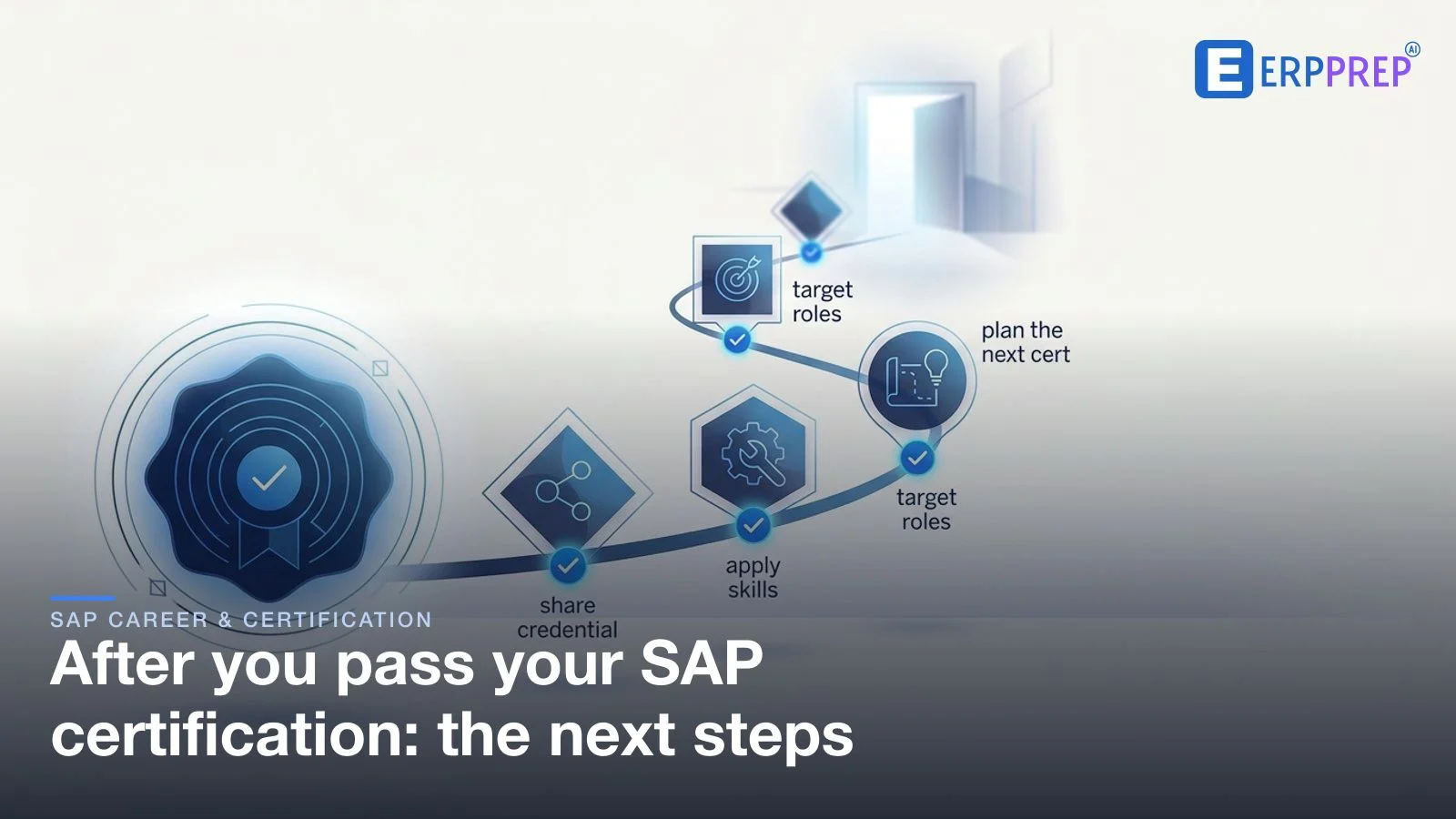
After you pass, treat the certification as a starting line: claim and share your digital credential, refresh your CV and LinkedIn with the specific skills it proves, apply those skills on real work quickly so they stick, target roles that actually use the module, and plan a second certification. Momentum in the first 90 days is what converts a pass into a career outcome.
You passed. The countdown, the practice, the exam-day nerves — done. It is worth pausing to enjoy it, because passing a performance-based SAP® exam is a real achievement. But the certification itself is a milestone, not an outcome: nobody gets hired, promoted, or paid more simply because a pass exists in a database. The outcome comes from what you do next. This is the playbook for turning a pass into a career result — and it fits inside the broader question of whether and how SAP certification pays off.
Key takeaways
- The certification is evidence, not a result — the career benefit comes from what you do in the weeks after you pass.
- Claim and share the digital credential immediately, and translate it into concrete skills on your CV and LinkedIn, not just an exam code.
- Apply the skills within weeks while the material is fresh — unused knowledge fades fast, and it is what interviews probe.
- Target roles that use the module, read the tasks in the job description, and aim where your certification and hands-on experience overlap.
- Plan a second certification only after the first one is embedded in real work — stack logically, don't collect.
Your first 90 days after passing
The single most useful thing you can do is not drift. Below is a simple sequence for the first three months — each step is expanded in the sections that follow. Treat it as a checklist, not a race: doing each step well matters more than doing all of them at once.
| Next step | What to do | When |
|---|---|---|
| Claim & share your credential | Accept the digital credential in your certification profile and add the verifiable link to LinkedIn. | Week 1 |
| Update your CV & LinkedIn | Rewrite your profile around the skills the exam proves, not the exam code alone. | Week 1–2 |
| Apply the skills on real work | Find a task, project, or realistic practice that uses the module while it is fresh. | Week 2–4 |
| Target the right roles | Read job descriptions for the tasks; apply where your skills and the role genuinely overlap. | Week 3–8 |
| Plan your next certification | Choose an adjacent module or the next tier that stacks logically on this one. | Week 6–10 |
| Keep it current | Follow release updates and renewal terms so your skills and credential stay credible. | Ongoing |
Claiming and sharing your digital credential
When you pass, SAP issues a verifiable digital credential rather than only a line on a certificate. The practical value of that is one word: verifiable. A recruiter can confirm it in a single click without emailing you or trusting a screenshot, which lowers the friction between "candidate claims a certification" and "certification confirmed." So the first move is to accept the credential in your certification profile and make it shareable.
- Add it to LinkedIn as a certification, including the verification link — not just the name typed into your headline.
- Link it from your CV so a hiring manager can check it in context, next to the skills it backs up.
- Reference it in application notes where relevant, but let the verifiable link do the convincing.
Two cautions. First, keep the trademark use accurate and modest — you are certified in a specific SAP solution, so name the exam precisely rather than implying a broader endorsement. Second, don't let the badge become the whole story. It opens the door; the sections below are what get you through it.
Turning the certification into interviews
A certification earns you a first look, but interviews are won on the ability to talk credibly about doing the work. The gap most newly certified people fall into is describing what they studied instead of what they can do. Close it by rewriting your story around tasks and outcomes.
Go through your CV and profile and replace "certified in module X" with the concrete things the certification proves you can do — the processes you can configure, the scenarios you can reason through, the settings you understand and why they matter. Recruiters and hiring managers screen for those tasks, so mirroring the language of real job descriptions makes your profile findable and legible.
It also pays to prepare a short, honest narrative you can repeat in every conversation: what you certified in, why you chose it, and one or two things you can already do with it. Interviewers are not looking for a recital of the syllabus — they want signal that you understand the business process behind the configuration and can explain a trade-off. Because performance-based exams reward reasoning over recall, the habits you built while preparing are exactly the habits that make you sound competent under questioning. Lean on them. For the evidence that a certification measurably helps at the shortlisting stage, see whether SAP certification helps you get hired, and to prepare for the conversations themselves, work through common SAP interview questions. The through-line: an interviewer wants to hear you reason like someone who has done the job, and a performance-based certification is your proof that you can.
Applying the skills so they stick
Here is an uncomfortable truth: knowledge you don't use starts fading within weeks. A performance-based exam tests whether you can complete tasks in a system or reason through a connected scenario — and that fluency decays if you stop practising the moment you pass. The fix is to put the skills to work quickly, ideally within the first month.
- Use it on the job. Volunteer for SAP-adjacent tasks in your current role — configuration, testing, support tickets, documentation — even small ones. Applied repetition is what turns exam knowledge into durable skill.
- Keep a realistic practice loop. If you don't yet have project work, keep rehearsing the doing-over-recalling style so the fluency holds. See hands-on SAP practice in 2026 for ways to stay hands-on between roles.
- Document what you configure. A short record of the processes you have set up becomes talking points for interviews and a reference for your next role.
Skills getting rusty between roles? A free sample keeps you in the doing-over-recalling groove the exam rewards — and reminds you what fluency feels like. Try a free sample.
Where to look for the right roles
Not every role that mentions SAP is a fit for a specific certification, and chasing the wrong ones wastes the momentum you have. The rule is to target roles that genuinely use the module you certified in, and to read the job description for the tasks rather than the title alone.
An associate certification maps well to junior consultant, functional analyst, and support roles — the positions where implementation and configuration skills are used every day. From there, accumulated project experience is what opens senior and lead roles, not another exam. If you certified in Financial Accounting on S/4HANA, for example, the C_TS4FI exam hub and the SAP FI consultant career path show how a finance certification typically ladders into roles. Aim where your certification and any hands-on experience overlap — that intersection is where you interview best and grow fastest.
It also helps to know what the day-to-day actually involves before you apply, so your applications and interview answers ring true — the overview of what an SAP consultant does is a useful reality check.
A practical tactic: pull five or six job postings that fit your certification and read them as a group. The tasks that repeat across all of them are the ones the market is actually hiring for — and the ones your applications, profile, and practice should foreground. If a skill you have appears in most postings, make it prominent; if a skill you lack appears everywhere, that is your next thing to learn before the interview, not after. Applying with intent to a handful of well-matched roles beats scattering generic applications at every listing that mentions SAP.
Planning a second certification
At some point the question arrives: should I certify in something else? The honest answer is not yet, and then deliberately. Immediately stacking a second exam on top of a first you haven't applied yet gives you two certifications and the experience of neither. Convert the first into real work before adding to it.
When you are ready, stack logically rather than collecting badges. A second certification pays off when it is an adjacent module that pairs with your first in real projects, or the next tier up once you have design-level experience. A scattered set of unrelated certifications signals less than two related ones with genuine work behind them. For how to choose that second exam so it compounds rather than dilutes your profile, see building a second SAP certification stack. And if you might move from an older landscape into S/4HANA work, the ECC-to-S/4HANA migration careers guide shows where the demand is heading.
Keeping your certification current
SAP has moved toward a staying-current model, which means a certification is something you maintain rather than a trophy you earn once. Products evolve release to release, and a credential is only as credible as the skills behind it — outdated knowledge shows quickly in an interview.
- Follow the delta updates for your solution so you know what has changed since you certified.
- Keep practising as the product changes, so your hands-on fluency tracks the current release rather than the one you studied.
- Check the renewal terms on your specific certification's page — validity and renewal rules vary by exam, so confirm yours rather than assuming.
For the full picture of validity, renewal, and why the model changed, see whether SAP certifications expire.
Avoiding the "certified but idle" trap
The most common way a certification fails to pay off has a name: certified but idle. Someone passes, feels the relief, and then does nothing with it for months — no profile update, no applied practice, no applications. By the time they act, the skills have faded, the achievement no longer feels recent, and the certification reads as a line on a page rather than a live capability.
Avoiding the trap is not complicated; it is about not stopping. Keep a small amount of momentum every week: apply a skill, refine your profile, have a conversation, send an application, do a practice set. If you passed but genuinely have no project experience yet, that is a gap to close on purpose — take on SAP-adjacent tasks where you are, join an implementation or support rotation if one is available, and document everything you configure so you can talk about doing the work, not just passing the exam. The certification bought you a head start; idleness spends it.
Where to go from here
Passing is the milestone; the next 90 days are the outcome. Claim the credential, translate it into skills, apply those skills fast, aim at roles that use them, and let a second certification follow real experience rather than replace it. From here, three useful next reads: the career pillar on whether certification is worth it to keep the bigger picture in view; how to stack a second certification when you are ready to build on this one; and hands-on practice to keep your skills sharp between roles. The certification opened the door — what you do this quarter decides how far you walk through it.
Frequently asked questions
- What should I do right after I pass my SAP certification?
- Claim your digital credential from the certification portal, then update your CV and LinkedIn with the specific skills the exam verified — not just the exam code. In parallel, find a way to apply those skills on real or realistic work within a few weeks, while the material is fresh. The single biggest mistake is stopping the moment you pass: the outcome comes from what you do in the following weeks, not from the pass itself.
- How do I share my SAP certification credential?
- When you pass, SAP issues a verifiable digital credential you can share from your credential profile. Add it to LinkedIn (as a certification, with the verification link), link it in your CV, and reference it in application cover notes. A shareable, verifiable credential is far more useful to a recruiter than a line of text, because they can confirm it in one click without contacting you.
- Does an SAP certification guarantee a job?
- No. A certification is evidence that you can do a defined set of tasks; it shortlists you and starts conversations, but hiring decisions turn on demonstrated, hands-on competence in interviews and on the job. Treat the certification as a door-opener that you back up with real project work, a clear story about what you can configure, and continued practice. On its own it is necessary for many roles but rarely sufficient.
- Should I get a second SAP certification straight away?
- Usually not immediately. First convert the one you have into applied experience — that is what employers actually value. Once the skills are embedded in real work, a second certification that stacks logically on the first (an adjacent module or the next tier) compounds your profile. Stacking two related certifications with genuine experience behind them beats collecting unrelated ones you never use.
- How do I keep my SAP certification current?
- SAP has moved toward a staying-current model, so treat certification as something you maintain rather than a one-time achievement. Follow the release and delta updates for your solution, keep practising as the product evolves, and check the renewal terms on your certification's page — they vary by exam. Keeping your skills current also keeps your credential credible in interviews, where outdated knowledge shows quickly.
- How long does it take to see a career benefit after certifying?
- It varies by your starting point and market, but the people who see a benefit fastest are the ones who move within the first 90 days — updating their profile, applying the skills, and starting conversations while the achievement is recent. Waiting months before doing anything with the certification is the most common reason it appears to have little effect. Momentum matters more than any single application.
- What roles should I target after an SAP certification?
- Target roles that genuinely use the module you certified in, and read job descriptions for the tasks — configuration, testing, support, or implementation — rather than only the title. Associate certifications map well to junior consultant, functional analyst, and support roles; from there, project experience opens the way to senior and lead positions. Aim where your certification and any hands-on experience overlap, not at the most senior title you can find.
- I passed but I have no project experience — what now?
- Close the experience gap deliberately. Build realistic hands-on practice, take on SAP-adjacent tasks in your current job, contribute to an implementation or support rotation if one is available, and document what you configure. The goal is to be able to talk credibly about doing the work, not just about passing. Certified-but-idle is the trap: skills fade fast without use, and interviewers can tell.
ERPPrep is an independent platform and is not affiliated with, endorsed by, or sponsored by SAP SE. SAP and other SAP products are trademarks of SAP SE, referenced here only to describe the certification exams ERPPrep helps you prepare for.
Ready to practise the way the exam tests?
ERPPrep provides original, performance-style scenarios and skill drills built for the 2026 SyBA and SBA formats. Try a free sample and judge the quality yourself.
Practice for these exams
Related guides
How to get your first SAP job after certification
A tactical playbook for turning a passed SAP certification into a first job offer: hands-on practice, realistic entry roles, a portfolio, and networking.
How to verify an SAP certification is legitimate
How to confirm an SAP certification is genuine — the digital badge, SAP Credential Manager, what a valid credential shows, and how recruiters check it.
SAP certification vs experience: what matters more?
Certification or experience for an SAP career? Both matter, at different stages — how employers weigh them by seniority, and how to build both.